


Reusable packaging has become a key trend in the logistics industry as businesses seek to reduce waste and cut costs.
Among the various reusable packaging solutions, PP corrugated sheet boxes represent an upgraded generation of corrugated plastic sheet containers that combine lightweight design with durable performance.
Made from polypropylene through an extrusion process, these boxes offer significant advantages over traditional corrugated cardboard in moisture resistance and service life, making them suitable for a wide range of industries from e-commerce fulfillment to cold chain transportation.
This article introduces the material properties, complete manufacturing process, structural design features, and practical application cases of PP corrugated sheet boxes, providing a comprehensive reference for businesses looking to adopt reusable packaging solutions.
Introduction to Reusable Packaging Products
This article provides a relatively detailed introduction to the PP corrugated sheet boxes—version 2.0 of the reusable packaging containers made from corrugated plastic sheets.
Here, we will discuss the PP corrugated sheet material and the manufacturing process for these containers.
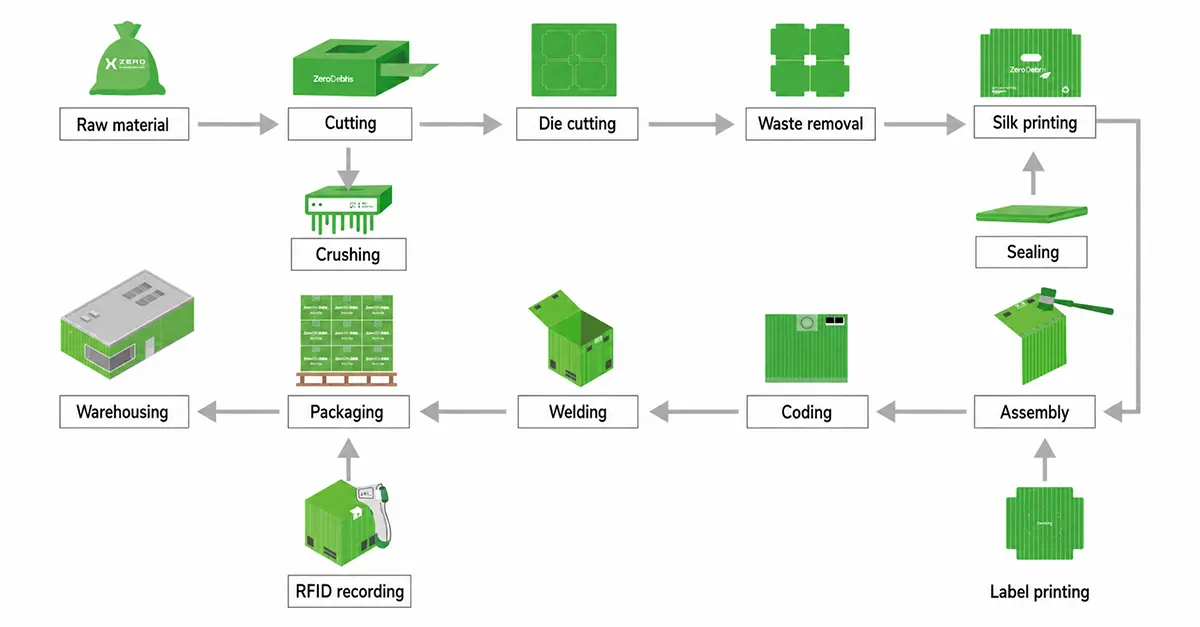
First, here is the process flowchart:
PP corrugated Sheets
Workers produce these sheets through an extrusion process using PP corrugated sheet production equipment.
They feed PP pellets into the feeder, heat and melt the material, then extrude, draw, shape and cut it to form ready-to-use PP corrugated sheets.
During this process, manufacturers can customize the color of PP corrugated sheets by adding different color masterbatches to achieve various hues, with blue, gray, black and pink being the most common.
People generally use black as the identifying color for conductive corrugated sheets.
Additionally, manufacturers can produce PP corrugated sheets in their natural, semi-transparent state to meet specific requirements.
Die-Cutting
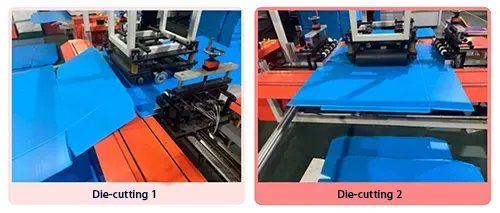
PP corrugated sheets can be die-cut using either hot or cold pressing.
Workers die-cut the packaging box according to the layout diagram. They trim off unwanted edges and corners. Meanwhile, they emboss crease lines on the board.
Printing and Edge Sealing
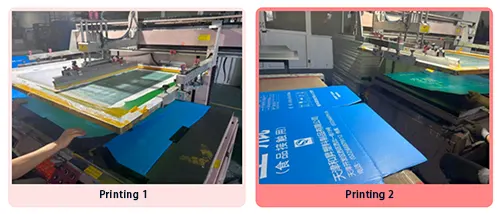
Workers apply screen printing to the die-cut panels, generally following the packaging box’s decorative surface specifications for content and color.
In addition, operators may perform hot-melt edge sealing based on specific process requirements to avoid sharp edges cutting staff or users.
Assembly and Marking
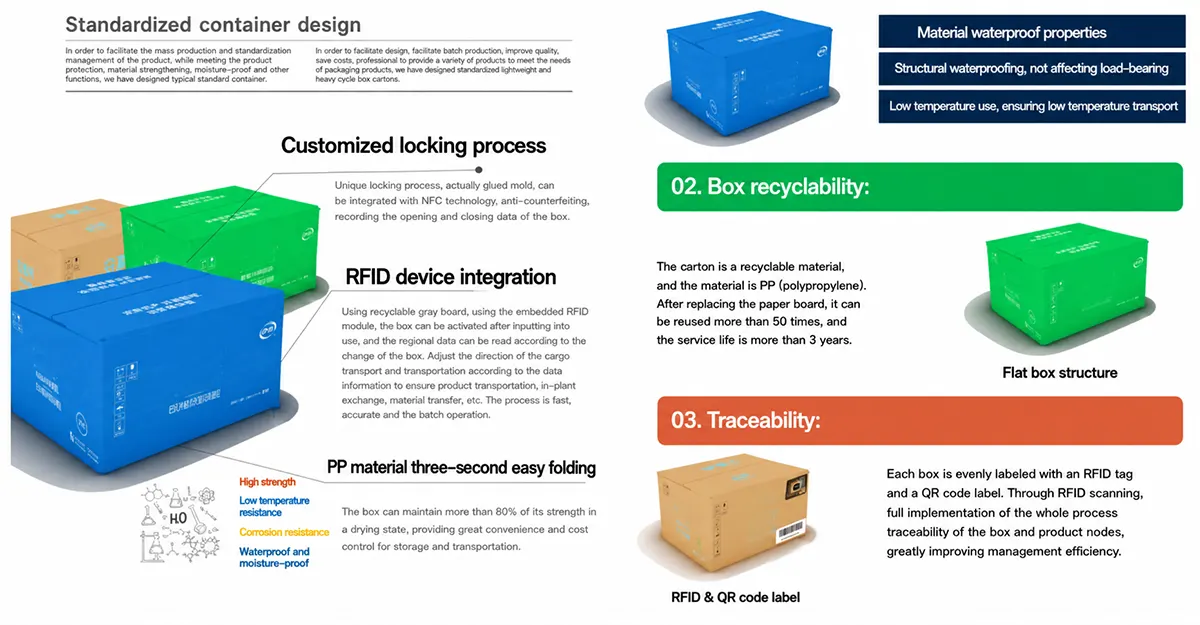
Assemble accessories—such as box latches and RFID chips—onto the printed corrugated panels;
Some boxes require different surface barcodes, and workers can laser-mark these barcodes at this stage to meet the “one box, one code” requirement.
Welding and Forming
When manufacturing packaging boxes, workers fold the sheet material along the die-cut crease lines to easily assemble it into a rectangular box.
The seams of the folded box are bonded using ultrasonic welding.
To further enhance strength, corner protectors are often added to the box’s corners, or a frame-type structure is used for reinforcement, enabling the box to withstand hundreds of kilograms of static stacking pressure.
Packaging and Warehousing
After workers fold and pack the welded boxes, they place the units on pallets and store them in the warehouse.
The structural design of PP corrugated sheet boxes is similar to that of corrugated cardboard boxes;
Designers can also configure the boxes with swing-lid, self-locking bottom, or top-and-bottom lid structures.
Due to the properties of plastic materials, PP corrugated sheet boxes are more durable than corrugated cardboard boxes in terms of moisture resistance and service life, but attention must be paid to photoaging (a form of UV aging, commonly treated with UV stabilizers) and thermal aging.
This is also why PP hollow-core plastic crates have become one of the mainstream types of reusable packaging containers.
Below is a brief introduction to two application cases (the following cases are based on actual examples from Greyscale Environmental Protection)
E-commerce Logistics & FMCG Retail Industry
Suitable for e-commerce fulfillment and sorting, express transit, FMCG warehousing and distribution, and store restocking scenarios.
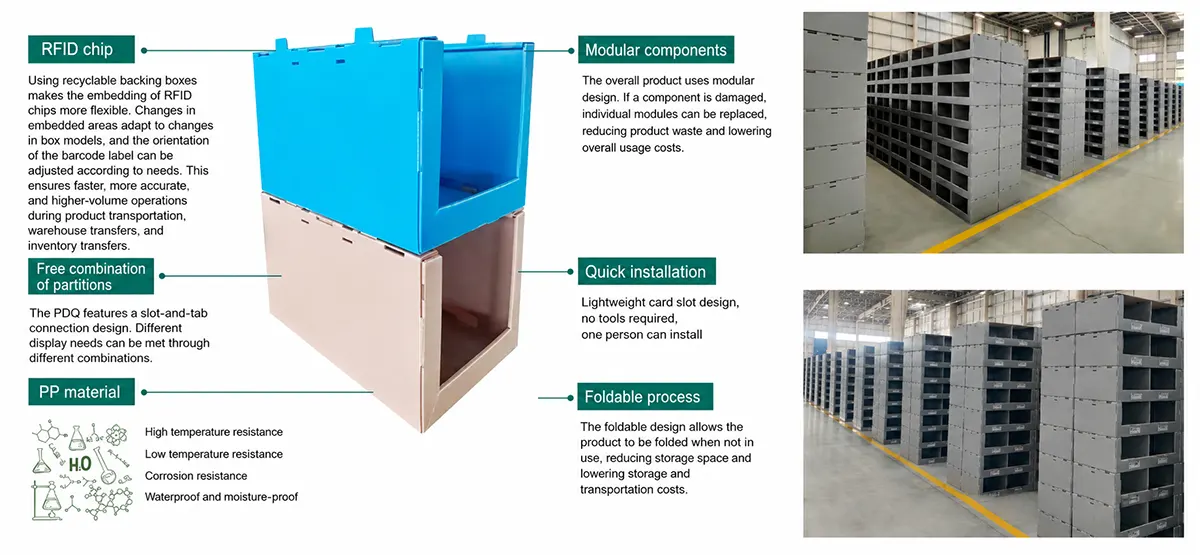
The crates feature a lightweight, foldable design that significantly saves storage space when not in use.
They can be reused repeatedly, replacing single-use cardboard boxes to reduce costs and waste, and are well-suited for high-frequency logistics handling, bulk stacking, and long-distance transportation.
Fresh Food & Pharmaceutical Cold Chain Industry
Made from food-grade, eco-friendly materials, these products are non-toxic, odorless, and washable and disinfectable, meeting industry hygiene standards.
They are suitable for the handling and short-distance cold chain transportation of fresh fruits and vegetables, prepared meals, central kitchen ingredients, and general pharmaceutical supplies.
They are waterproof, moisture-resistant, and resistant to low temperatures, making them ideal for clean, high-hygiene work environments.
Conclusion
PP corrugated sheet boxes have emerged as a mainstream reusable packaging option, thanks to their well-established manufacturing process and versatile structural designs.
The six-step production flow—from sheet extrusion through die-cutting, printing, assembly, welding, and final warehousing—ensures consistent quality and customizable features to meet diverse industry needs.
With applications spanning e-commerce logistics, FMCG retail, fresh food distribution, and pharmaceutical cold chains, these boxes deliver tangible benefits, including space savings through foldable designs, reduced waste through repeated reuse, and compliance with hygiene standards for food and pharmaceutical sectors.
While photoaging and thermal aging remain factors to consider in material selection, the overall durability, cost-effectiveness, and environmental advantages of PP corrugated sheet boxes position them as a practical and sustainable choice for modern packaging and logistics operations.