


Walk into almost any warehouse or manufacturing facility, and you may find a familiar packaging material: PP corrugated sheet.
Also known as polypropylene hollow sheet, PP hollow board, or corrugated plastic sheet, this material serves many industrial packaging applications.
Its cross-section looks similar to corrugated cardboard. Two flat outer layers connect through vertical ribs, creating a series of hollow channels.
The difference lies in the material. Traditional corrugated cardboard uses paper, while PP corrugated sheet uses polypropylene plastic.
This simple structure provides an effective combination of lightweight construction, moisture resistance, and reusability.
But is PP corrugated sheet suitable for every packaging application? How do you select the correct thickness and weight? What determines its price?
This guide explains everything buyers and engineers should know.
1. What Is PP Corrugated Sheet Made Of?
PP corrugated sheet is primarily manufactured from polypropylene (PP) resin through a plastic extrusion process.
During production, molten polypropylene passes through a specially designed extrusion die to form a hollow sheet.
The finished sheet typically contains two flat surfaces connected by multiple internal ribs.
These ribs create hollow channels between the outer layers.
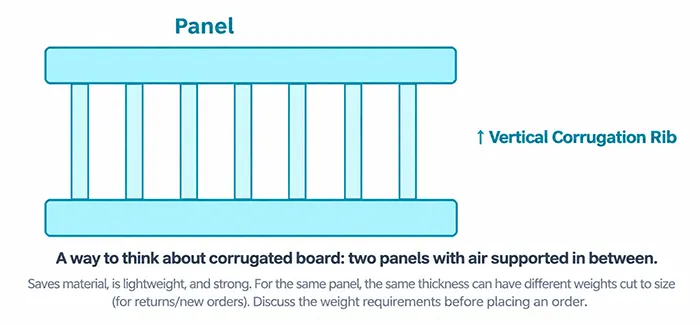
The hollow structure provides several practical advantages:
Lightweight construction: Hollow channels reduce material consumption compared with solid sheets.
Moisture resistance: Polypropylene does not readily absorb water.
Reusable design: Sheets can withstand repeated handling under suitable operating conditions.
Easy fabrication: Sheets can be cut, creased, folded, welded, or assembled.
Easy cleaning: Smooth plastic surfaces can be wiped or washed.
Customization: Manufacturers can offer different colors, thicknesses, weights, and functional formulations.
However, water-resistant sheets do not automatically create waterproof containers. Water may still enter through joints, openings, or connections.
2. Common PP Corrugated Sheet Specifications
Many buyers start with a simple question:
“How much does a 5mm PP corrugated sheet cost?”
Unfortunately, thickness alone cannot determine product performance or price.
Sheet weight, material composition, dimensions, and special properties also affect the final cost.
Common PP Corrugated Sheet Thicknesses
| Thickness | Typical Applications |
|---|---|
| 2 mm | Lightweight dividers and protective pads |
| 3 mm | Packaging inserts and lightweight partitions |
| 4 mm | Electronic component packaging and dividers |
| 5 mm | Reusable boxes and general industrial packaging |
| 6 mm | Automotive parts packaging and reinforced dividers |
| 8 mm | Larger reusable containers and protective packaging |
| 10 mm | Heavy-duty packaging and specialized partitions |
| 12 mm and above | Custom packaging and reinforced structures |
These applications are general references. Actual load capacity depends on sheet weight, structure, support conditions, and material properties.
Available Colors
Common PP corrugated sheet colors include:
Blue
Black
White
Gray
Green
Red
Yellow
Manufacturers may use different colors to identify products, production lines, or storage areas.
Black sheets are frequently used in electronics packaging. However, black color alone does not guarantee anti-static performance.
Buyers should verify electrical properties through appropriate testing.
Customization Options
PP corrugated sheet manufacturers may offer customization for:
Sheet length and width
Thickness
Weight per square meter
Color
Printing and branding
Anti-static or conductive properties
UV resistance
Flame-retardant formulations
Custom packaging structures
Special performance requirements should be supported by relevant testing and specifications.
3. What Are PP Corrugated Sheets Used For?
PP corrugated sheets support many industrial applications.
However, they offer particularly strong value when packaging materials can be reused repeatedly.
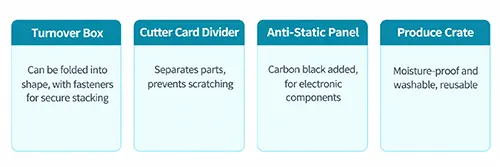
3.1 PP Corrugated Plastic Boxes
Reusable PP corrugated boxes are widely used in manufacturing plants, warehouses, and internal logistics systems.
Manufacturers can customize these boxes with handles, fasteners, reinforced edges, and internal dividers.
Compared with disposable cardboard boxes, they are often better suited to repeated handling and humid environments.
3.2 PP Corrugated Dividers and Partitions
PP corrugated dividers separate individual products inside a larger container.
They help reduce direct contact between components during transportation and handling.
Common applications include:
Automotive components
Electronic products
Metal parts
Precision-machined components
Plastic injection-molded parts
Surface-finished products
Manufacturers can cut slots into the sheets and assemble them into interlocking partitions.
For delicate surfaces, additional cushioning materials may still be necessary.
3.3 Anti-Static PP Corrugated Sheets
Electronic components can be sensitive to electrostatic discharge.
Standard polypropylene is generally an electrical insulator.
Manufacturers can modify the formulation to produce static-dissipative or conductive sheets.
These products are commonly used for:
PCB handling and storage
Electronic component boxes
Electronics production-line containers
Buyers should specify the required electrical resistance range and testing method.
3.4 Fruit and Vegetable Packaging
PP corrugated sheets are also used in agricultural and food distribution packaging.
Their moisture resistance and cleanable surfaces make them useful in selected cold-chain applications.
Typical products include reusable produce boxes, protective liners, and customized packaging containers.
For direct food contact, buyers must confirm compliance with applicable food-contact material requirements.
3.5 Automotive Parts Packaging
Automotive manufacturers frequently move components between production lines, warehouses, and suppliers.
PP corrugated packaging can support these internal logistics operations.
Typical products include reusable boxes, protective liners, partitions, and custom packaging inserts.
For heavier metal components, additional reinforcement or cushioning may be required.
4. Advantages and Disadvantages of PP Corrugated Sheets
PP corrugated sheets offer several advantages, but they also have limitations.
| Advantages | Limitations |
|---|---|
| Moisture-resistant material | Vulnerable to sharp objects |
| Lightweight construction | Limited stiffness over large spans |
| Reusable under suitable conditions | UV exposure can accelerate aging |
| Easy to clean | Limited high-temperature resistance |
| Can be folded into custom boxes | Low-temperature impact performance varies |
| Available in anti-static formulations | Specialized grades cost more |
| Polypropylene is recyclable | Recycling depends on local facilities and material condition |
One important consideration is load capacity.
Thickness alone does not determine how much weight a sheet or container can support.
Sheet weight, rib orientation, dimensions, structural design, and temperature all influence performance.
5. How Long Do PP Corrugated Sheets Last?
There is no universal service life for PP corrugated sheets.
Their durability depends on material quality, handling frequency, mechanical stress, and environmental conditions.
In indoor warehouses, properly designed reusable boxes may remain functional for several years.
However, frequent overloading, forklift impacts, or improper handling can shorten their lifespan.
Outdoor exposure creates additional challenges.
Prolonged sunlight can accelerate polypropylene degradation, causing discoloration, brittleness, or cracking.
For outdoor applications, buyers should consider UV-stabilized materials with verified weathering performance.
Regular inspections should focus on:
Cracks around folded edges
Damaged fasteners
Worn bottom panels
Deformed walls
Broken structural connections
Minor noncritical damage may sometimes be repaired. However, damaged load-bearing sections should be replaced.
In many cases, poor handling destroys reusable packaging faster than normal wear.
6. What Does PP Corrugated Sheet GSM Mean?
One of the most important purchasing specifications is sheet weight.
GSM means grams per square meter (g/m²).
It indicates the weight of one square meter of material.
For example, two sheets may both have a thickness of 5 mm.
However, one sheet might weigh 800 g/m², while another weighs 1,000 g/m².
Although their thicknesses are identical, their material consumption differs significantly.
Under comparable material and structural conditions, a heavier sheet may provide greater stiffness or strength.
However, GSM alone cannot guarantee mechanical performance.
How to Calculate PP Corrugated Sheet GSM
Use this formula:
GSM = Sheet Weight (g) ÷ Sheet Area (m²)
For example:
Sheet size: 1,000 × 2,000 mm
Sheet area: 2 m²
Sheet weight: 2,000 g
Calculation:
2,000 ÷ 2 = 1,000 GSM
This method is useful for incoming quality inspections.
Why Do Sheets With the Same Thickness Have Different Prices?
Several factors influence PP corrugated sheet prices:
Different sheet weights and material consumption.
Virgin polypropylene versus recycled material.
Different internal rib structures.
Anti-static, conductive, or UV-resistant additives.
Sheet dimensions and colors.
Order quantities and processing requirements.
Therefore, buyers should never compare quotations based on thickness alone.
Thickness, GSM, material composition, dimensions, and performance requirements should all be specified.
7. PP Corrugated Sheet vs. Cardboard vs. Solid PP Sheet
Different packaging materials serve different purposes.
| Feature | PP Corrugated Sheet | Corrugated Cardboard | Solid PP Sheet |
|---|---|---|---|
| Weight | Lightweight | Lightweight | Generally heavier at equal thickness |
| Moisture resistance | Good | Limited without treatment | Good |
| Reusability | Good | Depends on conditions | Good |
| Puncture resistance | Moderate | Moderate | Generally higher |
| Cleaning | Easy | Difficult | Easy |
| Fabrication | Cutting, folding, welding | Cutting, folding | Cutting, thermal processing |
| Common applications | Reusable boxes, dividers | Shipping cartons | Protective panels, industrial components |
For one-way shipping, cardboard often offers a lower initial packaging cost.
For repeated circulation in humid environments, PP corrugated sheets may provide better long-term value.
Solid PP sheets may be more appropriate when higher localized strength is required.
8. How Much Does PP Corrugated Sheet Cost?
Buyers frequently search for terms such as:
PP corrugated sheet price
5mm PP hollow sheet price
Corrugated plastic sheet price per square meter
Wholesale PP corrugated sheets
PP corrugated sheet manufacturer
However, there is no single price that applies to every specification.
The final quotation depends on several factors.
Main Factors Affecting Price
Material costs: Virgin and recycled polypropylene formulations have different cost structures.
Sheet weight: Higher GSM generally requires more raw material.
Thickness and dimensions: Different specifications affect manufacturing and processing requirements.
Functional additives: Anti-static, conductive, flame-retardant, and UV-resistant grades may cost more.
Order quantity: Larger production quantities can reduce certain setup and processing costs.
Secondary processing: Cutting, creasing, welding, printing, and box assembly increase the finished product cost.
Calculate Cost Per Use Instead of Purchase Price Alone
For reusable packaging, the initial purchase price is only part of the total cost.
A useful calculation is:
Cost Per Use = Packaging Purchase Cost ÷ Number of Effective Uses
Consider this hypothetical example:
| Packaging Type | Purchase Cost | Effective Uses | Cost Per Use |
|---|---|---|---|
| Cardboard box | $1.20 | 2 | $0.60 |
| PP corrugated box | $6.00 | 20 | $0.30 |
These figures are illustrative, not market quotations.
Actual costs should also include cleaning, repairs, return transportation, storage, and product losses.
Reusable packaging becomes more economical when businesses maintain a reliable return and circulation system.
9. How to Choose a Reliable PP Corrugated Sheet Manufacturer
Selecting the right manufacturer involves more than finding the lowest quotation.
For industrial packaging applications, consistent product quality is especially important.
Buyers should evaluate the following factors.
Raw Material Quality
Confirm whether the manufacturer uses virgin polypropylene, recycled polypropylene, or a specified blend.
Material composition can influence appearance, impact resistance, and durability.
Thickness and GSM Control
Ask for clearly defined thickness and weight tolerances.
Consistent specifications help reduce performance variations between production batches.
Dimensional Stability
Check whether sheets show excessive warping, shrinkage, or dimensional inconsistencies.
Mechanical Performance
For demanding applications, request relevant bending, impact, or compression testing.
Functional Properties
Anti-static, conductive, UV-resistant, and flame-retardant sheets should meet agreed testing requirements.
Custom Manufacturing Capabilities
A suitable supplier should understand the intended application and support practical packaging design.
Delivery and Quality Consistency
Stable production, documented inspections, and reliable delivery schedules are important for recurring orders.
For large-volume purchases, sample testing should take place before full production.
10. Premierplast: PP Corrugated Sheet Manufacturer in Shenzhen, China
Premierplast is a Shenzhen-based manufacturer specializing in PP corrugated sheets and customized plastic packaging solutions.
Located in one of China’s major manufacturing centers, Premierplast serves customers seeking practical, reusable packaging materials for industrial applications.
The company focuses on producing polypropylene hollow sheets and developing packaging solutions for manufacturing, warehousing, electronics, and component handling.
What Products Does Premierplast Offer?
Premierplast provides PP corrugated sheet products and customized packaging solutions for different industrial requirements.
PP Corrugated Sheets
Polypropylene hollow sheets can be produced in different thicknesses, weights, colors, and dimensions according to customer requirements.
These sheets serve as raw materials for protective packaging, dividers, and reusable containers.
PP Corrugated Plastic Boxes
Reusable plastic boxes support internal transportation, warehouse storage, and industrial parts handling.
Box dimensions and configurations can be adapted to specific products.
PP Corrugated Dividers and Partitions
Custom-cut partitions separate individual components and reduce direct contact during transportation.
These solutions are useful for automotive parts, electronic products, and precision-manufactured components.
Anti-Static PP Corrugated Sheets
For electronics applications, Premierplast can discuss material options designed for electrostatic protection.
Required electrical properties should be confirmed through appropriate testing and agreed specifications.
Customized Industrial Packaging
Customers can provide drawings, samples, product dimensions, or packaging requirements to develop suitable solutions.
Why Work With a Shenzhen PP Corrugated Sheet Factory?
Shenzhen is a major manufacturing center with extensive electronics, automotive, and industrial supply chains.
Working with a local PP corrugated sheet manufacturer can make sample evaluation, packaging discussions, and production coordination more convenient.
Premierplast can help customers consider important packaging factors, including:
Sheet thickness and GSM
Product dimensions and weight
Rib orientation and structural design
Handling and stacking requirements
Reuse frequency
Moisture exposure
Anti-static or other functional requirements
For reusable industrial packaging, appropriate material selection and structural design can help control long-term costs.
From PP Corrugated Sheets to Customized Packaging
Industrial packaging should protect products while supporting efficient handling and transportation.
A well-designed packaging solution considers the entire application rather than the sheet material alone.
For example, electronic components may require electrostatic protection, while automotive parts may need reinforced partitions.
Warehouse containers may require different handling features depending on stacking height and transportation methods.
Premierplast works with customers to identify suitable PP corrugated sheet specifications and packaging structures.
Request a Quote From Premierplast
Looking for a PP corrugated sheet manufacturer in Shenzhen, China?
Premierplast provides PP hollow sheets, reusable plastic boxes, dividers, and customized industrial packaging solutions.
To request a quotation, prepare the following information:
Required sheet thickness and GSM
Length, width, and quantity
Preferred color
Product weight and packaging dimensions
Special requirements, such as anti-static properties
Drawings or samples, if available
Providing complete specifications helps the manufacturer evaluate material requirements and prepare a more accurate quotation.
Contact Premierplast to discuss your PP corrugated sheet and customized packaging requirements.
11. Five Common Mistakes When Buying PP Corrugated Sheets
Mistake 1: Comparing Thickness Without Checking GSM
Two sheets with the same thickness can have different weights and mechanical properties.
Always specify both thickness and GSM.
Mistake 2: Choosing the Lowest Price Without Checking Materials
Different material formulations may affect flexibility, impact resistance, appearance, and service life.
Evaluate materials according to the actual application.
Mistake 3: Ignoring Rib Orientation
PP corrugated sheets have directional structural characteristics.
Their bending behavior can vary depending on the direction of the internal ribs.
Packaging designers should consider rib orientation when designing larger panels and partitions.
Mistake 4: Skipping Load Testing
Sheet thickness and GSM do not directly determine the load capacity of a finished box.
Actual loading, stacking, and handling tests are essential.
Mistake 5: Assuming Black Sheets Are Anti-Static
Black polypropylene sheets are not necessarily suitable for ESD-sensitive products.
Request electrical performance specifications and appropriate test reports.
12. Frequently Asked Questions About PP Corrugated Sheets
Q1: What is the difference between PP corrugated sheet and PP hollow sheet?
These names generally describe the same type of twin-wall polypropylene sheet with internal hollow channels.
Terminology may vary between manufacturers and markets.
Q2: Are PP corrugated sheets waterproof?
Polypropylene sheets provide good water and moisture resistance.
However, containers assembled from these sheets may not be completely waterproof at joints or openings.
Q3: Can PP corrugated sheets be folded?
Yes. Suitable cutting, creasing, or thermal processing methods allow sheets to be folded into packaging structures.
The appropriate method depends on thickness and design.
Q4: How much weight can a PP corrugated sheet support?
Load capacity depends on sheet thickness, GSM, dimensions, rib orientation, support conditions, and structural design.
There is no universal load rating for all PP corrugated sheets.
Q5: What is the difference between anti-static and standard PP corrugated sheets?
Standard PP corrugated sheets are generally insulating materials.
Anti-static or static-dissipative sheets use modified formulations to control electrical properties.
The required performance should be specified and tested.
Q6: Are PP corrugated sheets recyclable?
Polypropylene is a recyclable thermoplastic.
Actual recycling options depend on local facilities, contamination levels, and material composition.
Q7: Can PP corrugated sheets be used outdoors?
Yes, but ordinary polypropylene can degrade under prolonged UV exposure.
UV-stabilized grades with suitable weathering performance are recommended for extended outdoor use.
Q8: Are PP corrugated boxes cheaper than cardboard boxes?
Cardboard boxes often have a lower initial purchase price.
However, PP corrugated boxes may offer lower cost per use in repeated circulation systems.
Q9: What thickness is best for PP corrugated boxes?
Common box applications may use 3mm to 8mm sheets, depending on the product and packaging design.
Actual thickness selection should consider weight, dimensions, stacking requirements, and GSM.
Q10: Can PP corrugated sheets be customized?
Yes. Manufacturers can customize dimensions, thickness, GSM, color, printing, and packaging structures.
Specialized material formulations may also be available.
13. Conclusion: When Should You Choose PP Corrugated Sheets?
PP corrugated sheets are not designed to replace every cardboard box, wooden crate, or solid plastic container.
Their greatest advantages appear in applications requiring reusable packaging, moisture resistance, lightweight handling, and customized protection.
Before purchasing, buyers should focus on three essential factors:
Selecting the correct sheet thickness.
Confirming GSM and material specifications.
Verifying structural performance under actual operating conditions.
Electronics manufacturers should also evaluate electrostatic protection requirements.
Outdoor applications require additional consideration of UV resistance and material aging.
For one-way shipping, cardboard may remain the more economical choice.
For frequent industrial circulation, PP corrugated packaging can provide practical long-term benefits.
Premierplast, a PP corrugated sheet manufacturer in Shenzhen, China, offers material and packaging customization for industrial applications.
Whether you need PP hollow sheets, reusable boxes, anti-static packaging, or custom dividers, choosing the correct specifications is more important than simply selecting the lowest price.
The right material and packaging design can improve product protection, support efficient handling, and reduce long-term packaging costs.