


There are many types of roofing materials available for multi-span smart greenhouses, and selecting the appropriate material based on specific environmental conditions and usage requirements is crucial. Polycarbonate (PC) Corrugated sheets have been available in China for 20 years.
Due to their high transparency, high strength, light weight, thermal insulation properties, and ease of installation, they are widely used in agricultural greenhouse projects.
Over the years, through the efforts of professional R&D personnel, polycarbonate (PC) Corrugated sheets have not only undergone significant structural improvements but have also seen leapfrog advancements and innovations in quality and performance.
Concept
Polycarbonate (PC) sheets are divided into two main categories: solid sheets and Corrugated sheets.
Corrugated sheets (also known as sunlit panels) are double- or multi-layered hollow panels manufactured primarily from high-performance polycarbonate (PC) resin.
These energy-efficient and environmentally friendly plastic panels offer outstanding overall performance and serve as widely used international building daylighting materials.
Developers widely apply them in building roofs and curtain walls, as well as in skylights for sports venues, airports, and train stations.
Additionally, it finds applications in sunshades, agricultural greenhouses, flower markets, bus shelters, lightbox advertisements, and architectural decoration.
Advantages and Disadvantages
Polycarbonate (PC) Corrugated sheets have the following characteristics: high impact resistance, superior to glass, with virtually no risk of shattering;
Lightweight, weighing only one-tenth as much as insulated glass, which significantly reduces the load on steel structures;
Excellent thermal insulation properties, as they inherently possess the structure and functions of insulated glass;
Simple to install and fabricate, they can be cold-formed, increasing design flexibility;
High light transmission, which does not affect the light required for plant growth.
In recent years, however, builders have shown a declining preference for using PC Corrugated sheets as greenhouse covering materials.
The primary reasons include the rapid decline in light transmission, as well as prominent issues such as yellowing and brittleness; moreover, their service life falls far short of that of glass.
According to surveys conducted within a certain scope, there are very few actual cases where the material has lasted 10 years; generally, yellowing and embrittlement begin after as little as 3–4 years or as long as 5–6 years, necessitating replacement.
By the time they reach 10 years of use, many greenhouses have already had their panels replaced 1–2 times, which has inadvertently increased the operational costs of the greenhouses.
Performance Evaluation Methods and Metrics
Ageing resistance, light transmittance, and yellowing rate are key factors in determining the quality of PC sheets, and ageing resistance directly determines the service life of PC sheets.
Resistance to Aging
Ultraviolet (UV) radiation and the inherent stability of the material itself primarily cause the aging of organic chemical materials.
Therefore, to ensure the anti-aging properties of PC sheets, it is necessary to ensure the stability of the raw materials on one hand, and to apply an effective UV-protective coating to the sheet surface on the other.
1. Stability
Two factors determine the stability of raw materials: ① the inherent quality of the raw materials, including whether manufacturers add recycled materials.
② the specific formulation of the sheet material and the additives used to enhance physical properties.
2. UV Protection Process
UV protection technology directly impacts the service life of PC sheets.
Three Main Types of UV Protection Methods
A technical analysis of the specific methods for applying UV protective coatings to PC sheets reveals the following three types:
(1) Basic UV Absorber Coating Technology
Coating the surface of PC sheets with a UV absorber, or adding a UV absorber at an extremely low concentration to the PC raw material.
This process provides UV resistance for a relatively short period of time.
(2) In-line co-extrusion UV protection technology.
This involves adding a UV absorber at a specific concentration (typically 5%–7%) to the PC raw material and co-extruding it onto the surface layer of the PC sheet at a specific thickness (30–50 μm). This process significantly improves the UV protection of the PC sheet.
However, ① since the concentration of UV absorbers in the PC raw material cannot be too high, it is impossible to guarantee 100% UV blockage;
② UV absorbers have inherent limitations in quality and lifespan, which prevent them from absolutely guaranteeing the anti-aging performance of PC sheets.
③ UV absorbers in the co-extruded layer of a certain thickness can adversely affect the molecular structure of the PC raw material.
In severe cases, they break the molecular chains of the PC raw material, leading to sheet embrittlement and reduced impact strength.
The above shortcomings represent insurmountable bottlenecks in improving the long-term light transmittance and service life of PC sheets.
(3) Chemical Vapor Deposition (CVD) UV-Resistant and Thermosetting Technology.
In the 1990s, General Electric (GE) in the United States developed a new UV-resistant process—CVD UV-resistant and thermosetting technology.
This new technology involves thermally curing a chemical coating—composed of highly stable UV-absorbing materials and inherently weather-resistant materials—onto the surface of the PC sheet, ensuring better weather resistance and reduced yellowing;
It overcomes the significant variations in weather resistance performance caused by differences in the types and concentrations of UV absorbers used in co-extrusion layer technology.
Advantages of CVD UV-Resistant Technology
This new technology breaks through the bottleneck in improving the UV resistance of organic chemical materials.
It significantly extends the service life of PC sheets and represents a revolutionary leap in PC sheet production technology.
From a functional perspective, this new process technology enables manufacturers to incorporate various additional functions into PC boards.
Using chemical plating technology, manufacturers can also apply different non-conductive materials to PC boards to enhance their functionality.
For example, applying a quartz coating increases the surface hardness and abrasion resistance of the PC board;
Applying an anti-condensation coating, which thermosets the anti-condensation layer onto the board surface, making it resistant to peeling and extending the coating’s service life;
Applying UV or infrared protective coatings; applying double-sided UV-resistant coatings; and applying dust-repellent and easy-to-clean functional coatings, among others.
Functional Enhancement and Optical Performance
In summary, chemical coating processes can enhance and add functional properties to PC sheets.
Sheets produced using this UV-resistant technology not only block 100% of UV rays but also improve the surface leveling and smoothness of the PC sheets, thereby enhancing their optical properties.
Even in multi-layer hollow sheets, there is no visual distortion or deformation, and when used for greenhouse facades, they offer excellent visual transparency.
Comparison Between Coating and Co-Extrusion Methods
When comparing chemical coating UV protection with co-extruded layer UV protection, there are many factors that influence the effectiveness of the co-extruded UV-resistant layer on PC sheets.
First, the concentration of the UV absorber itself varies; second, the service life of the UV absorber itself differs; third, the quality levels of the UV absorbers themselves;
And fourth, the uniformity of mixing the UV absorbers into the PC raw material and during extrusion, which varies due to equipment limitations.
Therefore, the UV protection effectiveness achieved through the co-extrusion process can vary significantly.
Furthermore, UV absorbers are inherently colorless and transparent; therefore, it is unscientific to assess the UV protection of the sheet by visually inspecting the color of the co-extruded UV-absorbing layer.
Light Transmittance and Yellowing Rate
The light transmittance of polycarbonate (PC) Corrugated sheets depends on the following factors:
Pure raw materials; select the best, brand-new raw materials with high light transmittance;
› Importance of Light Transmittance in Greenhouse Applications
The light transmittance of various additives must be above 98%;
The sheets must have high flatness and surface finish after extrusion.
The light transmittance of polycarbonate (PC) Corrugated sheets is a critical factor for greenhouse lighting.
For greenhouses, although roofing materials account for a relatively small proportion of the total cost, they are crucial to the greenhouse’s appearance and serve as its “face”;
It is also a key reflection of the practical value of greenhouse lighting applications.
The primary beneficiaries of a greenhouse are the plants, which require temperature and sunlight above all else;
Consequently, the most critical requirement for greenhouse covering materials is light transmittance.
› Aging Resistance and Yellowing Performance Comparison
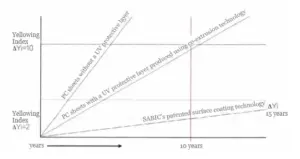
The SABIC Basic Innovation Plastics R&D Center (formerly the GE R&D Center in the U.S.) conducted aging resistance tests on products manufactured using different processes.
As shown in Figure 1, products without a UV-resistant co-extruded layer age very quickly, typically within three years;
Products with a UV-resistant co-extruded layer exhibit a significantly extended lifespan, lasting up to 10 years with a yellowing index ∆Yi not exceeding 10;
Whereas Sabic Innovative Plastics’ chemically coated UV-resistant products maintain a yellowing index ∆Yi of no more than 2 over 10 years, with light transmittance degradation not exceeding 2% over the same period.
› Relationship Between Yellowing and Service Life
Yellowing of the product indicates a decline in light transmittance and the onset of aging.
Improving the product’s anti-aging performance and reducing the yellowing rate helps maintain good light transmittance.
When PC sheets maintain strong light transmittance and stable mechanical properties over the long term, and when they outperform ordinary glass or insulated glass in other aspects, they become an excellent material for greenhouse lighting and covering applications.
Practical Applications
There are many similar products to polycarbonate (PC) sheets, such as Israel’s Temp, Polygon, and Palam; the former German company Bayer (now Covestro);
And Taiwanese brands such as Shangya, Gaofeng, and Lijialong, China currently has dozens of brands as well, each with its own unique characteristics, which we will not list individually here.
Focus on SABIC Innovative Plastics and GE Technology Legacy
For the purposes of this analysis, we will focus on the PC sheet products from SABIC Innovative Plastics (China) Co., Ltd. Sabic Innovative Plastics’ products are the same as those formerly produced by the Plastics Group of General Electric (GE) in the United States.
In 1953, GE pioneered the development of polycarbonate (PC) resin and quickly moved into the stages of deep processing and application.
By the early 1970s, manufacturers were already using it to produce daylighting materials, including solid and hollow sheets.
With over 40 years of production history, the company has now obtained more than 10,000 international patents.
The company offers a product range that covers hundreds of varieties and includes many innovative solutions.
These products include self-cleaning anti-condensation panels, infrared-blocking high-thermal-insulation hollow panels, frosted light-diffusing multilayer panels, zigzag high-transmittance structural panels, and photovoltaic composite panels integrated with flexible solar panels, among others.
Long-Term Performance and International Case Studies
Saudi Basic Industries Corporation (formerly GE) has supplied PC panels internationally that demonstrate service lives of 20 to 30 years.
The roof of the Amsterdam Arena in the Netherlands provides a typical case study of this long-term performance.
In 2010, the roof of the Amsterdam Arena in the Netherlands had been in use for 15 years.
A leading European third-party testing agency, TNO, conducted on-site sampling and testing.
The results showed that the sheets experienced a light transmittance reduction of no more than 1.12% compared to the initial product values.
The test recorded a yellowing index of ∆Yi = 1.31 for the sheets.
Based on this data, calculations show that if a new 10 mm transparent corrugated sheet starts with 80% light transmittance, the value decreases to 78.88% after 15 years (some new sheets may start at 78%), and further drops to 77.76% after 30 years.
Industry standards in China set a 10-year warranty requirement, requiring light transmittance decay of no more than 6% after 10 years.
Based on current warranty standards in China (yellowing index not exceeding ∆Yi=10), analysts estimate that the sheet will require at least another 10 years before its light transmittance declines to this limit.
Service Life Classification and Engineering Implications
These test results mark Sabic Innovative Plastics’ PC sheet products as semi-permanent (25-year) architectural daylighting materials.
In China, early application cases of Sabic Innovative Plastics (formerly GE) include the Oriental Plaza east of Wangfujing in 1998 (GE 16mm clear Corrugated sheets);
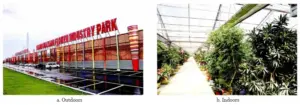
And the greenhouse at the Beijing Huaxiang Floral Industry Park Flower Market in 2001 (15,000 m² of GE 6mm transparent double-glazed anti-condensation panels).
These installations have been in use for over 15 years, and visual inspection shows no significant change in the light transmittance of the PC panels; they remain in service to this day.
Customers have responded positively to self-cleaning anti-drip panels.
Recent Landmark Applications and Performance Stability
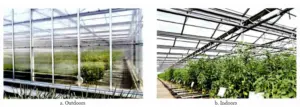
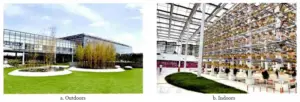
Beginning in 2012, developers launched several landmark greenhouse projects, including the International Floral Culture City Greenhouse, the 2014 World Seed Congress Greenhouse, and the COFCO Group Smart Farm Greenhouse.
Judging from the application results, the effects are quite noticeable.
After several years, the visual light transmittance has not changed; in particular, the surface of the panels remains very clean after rain. Both the roof and the walls offer excellent transparency.
Conclusion
In summary, polycarbonate (PC) Corrugated sheets are an excellent choice for greenhouse roofing and daylighting materials.
However, as with any product, there are variations in the quality of PC sheets.
Making the right product selection is a crucial step in ensuring the quality of greenhouse construction.
Merely pursuing low-cost and low-price products makes it difficult to achieve “excellent quality,” or rather, products sold below cost cannot provide a genuine guarantee of quality.
Advanced science and technology, coupled with a rigorous spirit of craftsmanship, are the only guarantees of product quality.
This requires industry professionals to adopt a scientific approach when selecting products.
Manufacturers and industry professionals should analyze products using scientific methods, evaluate product quality through data-based assessments, and support product warranties with concrete evidence.
They should also determine product pricing by comparing overall performance with actual value.
In this way, we are not only being responsible to ourselves, but also to our clients, and above all, to the project itself.