


In industrial packaging, corrugated sheet boxes are more moisture-resistant than ordinary cardboard boxes, lighter than wooden crates, and more cost-effective than single-use packaging.
In today’s article, we’ll break down corrugated sheet boxes into the five most common and practical types to help you quickly determine which box style is best suited for your specific needs.
What Are Corrugated Sheets Boxes?
Corrugated plastic crates, also known as corrugated plastic crates or Wantong crates, are primarily made of polypropylene (PP) Corrugated sheets.
They consist of two flat layers on the top and bottom, with longitudinal reinforcing ribs sandwiched in between, forming a “sheet-rib-sheet” hollow structure.
This structure allows the crates to remain lightweight while offering good compressive and flexural strength.
Manufacturers typically make the sheet thickness range from 2 to 10 millimeters, and they can customize the color, dimensions, and modifications as needed.
Five Main Types of Containers
Standard Stackable Returnable Containers
The most common type, featuring flat sides and a reinforced bottom.
Manufacturers design the lid or bottom with an interlocking mechanism to ensure stability and prevent slipping when users stack it in multiple layers.
Features: Simple structure, controllable costs, and easy to clean.
Load Capacity: 30–80 kg per container; stackable 4–6 layers high.
Applications: Warehouse circulation, production line flow, and inter-workshop transport.
Folding Double-Hinged Lid Container
Based on the standard container, this design adds a double-hinged lid that opens to the left and right, allowing items to be placed or removed without fully lifting the lid.
Manufacturers allow users to fold the four walls and close the lid when returning empty, significantly reducing the volume.
Features: Easy to open and close, dustproof and loss-proof, compact return volume.
Advantages: Saves space during empty container transport; Suitable for circular distribution.
Applications: E-commerce delivery, automotive parts, long-distance logistics.
Container with Adj
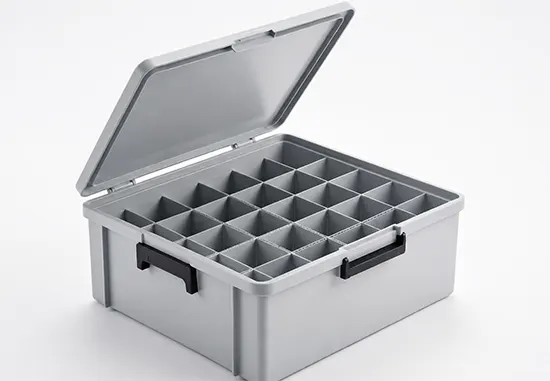
Users can equip the box with freely configurable dividers to partition the interior into several independent compartments.
Each compartment holds a single type of part or product, preventing them from bumping into one another and facilitating inventory checks and restocking.
Features: Users can adjust and rearrange the dividers to accommodate changes in products.
Advantages: Reduces the need for small packaging, increases packing density, and simplifies management.
Applications: Electronic components, hardware fittings, and small mechanical parts.
Anti-Static Electronic Component Storage Containers
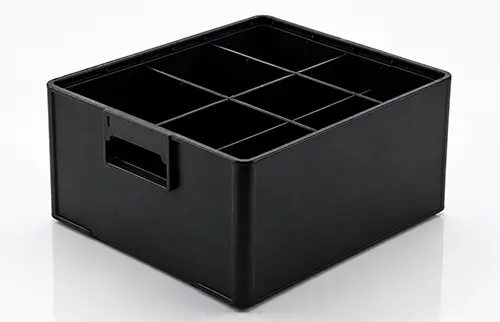
Adding conductive or antistatic masterbatch to PP corrugated sheets keeps the case’s surface resistance at 10⁶–10⁹ Ω and prevents electrostatic discharge from damaging sensitive components such as PCBs, chips, and batteries.
Features: Solid black or dark gray; long-term stability of conductive performance.
Advantages: Washable, reusable, and with no decline in antistatic performance.
Applications: PCBs, IC chips, connectors, and battery modules.
Heavy-Duty Logistics Containers
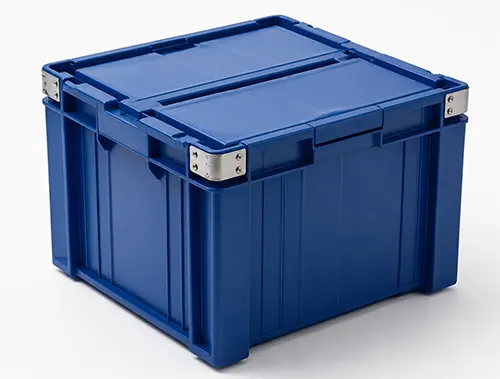
Manufacturers build the box with thicker hollow panels (typically 5–8 mm).
They add reinforcing ribs to the box walls and fit riveted metal corner guards on the four corners to deliver higher overall impact resistance, improved stacking strength, and a longer service life.
Features: Thick panels + metal corner guards + reinforcing ribs.
Advantages: Supports loads of 80 kg or more, stackable 6–8 layers high, and durable for 3–5 years.
Applications: Automotive parts, mechanical components, heavy-duty battery packs.
Why Are corrugated sheets Boxes So Popular?
Lightweight and Strong: Over 60% lighter than wooden crates while offering the same strength, making them easier to handle.
Waterproof and Moisture-Resistant: The plastic material does not absorb water, making them ideal for storage in rainy weather and cross-border ocean shipping.
Reusable: Can be reused over 100 times; the cost per use is significantly lower than that of cardboard boxes.
Easy to Customize: Can be perforated, labeled, screen-printed, and riveted, allowing for flexible customization.
Eco-Friendly and Recyclable: Made of PP material, they are recyclable and align with low-carbon trends.
Tips for Selection and Use
① Check the material. corrugated sheetss made from virgin PP pellets have uniform color and high strength;
Those containing recycled material are cheaper but more brittle and have a shorter lifespan.
② Check the structure and thickness.
For general logistics, choose 3–4 mm thick boards; for heavy-duty logistics, choose 5–8 mm.
The higher the load capacity, the thicker the board and the denser the ribs.
③ Consider suitability for the application.
Choose waterproof models for humid environments, anti-static models for electronic components, and add dividers or cushioning for precision parts.
④ Examine post-production processing. Whether operations such as cutting, riveting, hinging, and screen printing are performed to standard directly affects the box’s lifespan and user experience.
In summary, while there are many variations of corrugated sheet boxes, they all share four core characteristics: “lightweight, strong, moisture-resistant, and recyclable.”
From standard stackable models to anti-static and heavy-duty variants, you can find the most suitable box type by aligning your selection with the product’s attributes, circulation frequency, and transportation environment.