


In 1998, the United States, Canada, the European Union, and other countries imposed restrictions on the export of wooden pallets and packaging crates from China, imposing cumbersome and cost-increasing requirements such as fumigation and quarantine.
In 2003, the EU introduced the Waste Electrical and Electronic Equipment (WEEE) Directive and the Restriction of Hazardous Substances (RoHS) Directive, accelerating the global shift toward environmentally friendly packaging for electronic products.
China is a country with extremely scarce forest resources; reducing deforestation and maintaining ecological balance are long-term national policies to ensure sustainable development.
The adoption of wood-substitute packaging to reduce timber consumption has been designated as a national industrial policy.
How China can align with the global trend toward non-toxic and environmentally friendly practices has become an urgent issue requiring resolution.
Vigorously developing plastic corrugated sheets is one of the solutions to this problem.
Definition and Types of Plastic Corrugated Sheets
Plastic corrugated sheets, also known as plastic hollow sheets, Wantoong sheets, corrugated sheets, wave sheets, or double-wall sheets, are a type of plastic profile sheet with characteristics similar to corrugated cardboard.
Plastic corrugated sheets come in a variety of cross-sectional shapes; Figure 1 shows schematic diagrams of several cross-sectional shapes of plastic corrugated sheets produced by Omipa.
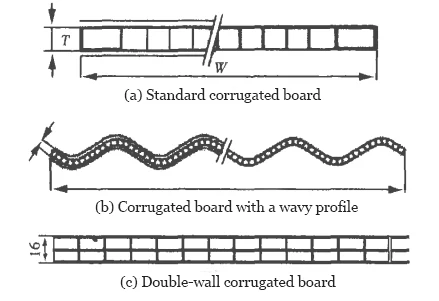
Raw Materials and Manufacturing Processes
Currently, the primary raw materials used in the production of corrugated sheets are PP (polypropylene) and PC (polycarbonate).
There are two methods for forming plastic corrugated sheets: one involves simultaneously extruding the core material and the face sheets on a single extruder, where the melt is divided into three layers within the die’s flow channels: the top and bottom layers form the flat sheets, while the middle layer forms the core of the plastic corrugated board.
To maintain the shape of the core and face layers, air cooling and cooling rolls are used instead of a three-roll calender for shaping.
The other method involves first extruding the sheets and then forming the plastic corrugated board.
The core and face layers are extruded using different extruders and then laminated together to form the final product.
Plastic corrugated boards have found widespread application in both industrial production and daily life, yet theoretical research in this area remains limited.
This paper introduces the applications and research progress of plastic corrugated boards, providing a foundation for further research in this field.
Advantages of Plastic Corrugated Sheets
Plastic corrugated sheets can serve as alternatives to cardboard, wood, aluminum, and glass in many applications.
Due to their plastic composition, they offer numerous advantages over these materials.
Compared to solid plastic sheets made of the same material, plastic corrugated sheets have several unique advantages, specifically:
1) Excellent mechanical properties. The unique structure of plastic corrugated panels endows them with superior mechanical properties, including good toughness, impact resistance, high compressive strength, shock absorption, high rigidity, and good flexibility.
These mechanical properties cannot be matched by corrugated paper or honeycomb paperboard.
2) Lightweight and material-efficient. Due to their superior mechanical properties, plastic corrugated panels require less material to achieve the same results, resulting in lower costs and lighter weight.
3) Thermal and sound insulation. The hollow structure of plastic corrugated panels significantly reduces heat and sound transmission compared to solid plastic sheets, providing excellent thermal and sound insulation.
4) Reduced processing time. Excessively thick walls prolong molding time; calculations show that doubling the wall thickness quadruples cooling time.
Plastic corrugated panels improve mechanical strength through thin-wall combinations rather than increased wall thickness, thereby enhancing processing efficiency.
5) Anti-static or conductive properties. Through methods such as modification, blending, and surface coating, plastic corrugated panels can be made anti-static or conductive.
6) Chemically stable; resistant to water, moisture, insect damage, and corrosion; offering significant advantages over corrugated cardboard, honeycomb paper, and wooden boards.
7) Smooth, attractive surface with a full range of colors.
8) Low-pollution manufacturing process; recyclable. Although not easily biodegradable, the overall environmental benefits are clearly superior when considering the entire lifecycle from raw materials through manufacturing to use.
Applications of Plastic Corrugated Sheets
Plastic corrugated sheets are widely used in the building materials, automotive, electronics, advertising, and postal industries. Currently, they are most commonly used in the following areas:
1) Parts transport boxes, instrument transport boxes, beverage transport boxes, pesticide transport boxes, inner packaging for precision instruments, pharmaceutical packaging boxes, postal packaging boxes, and cushioning and partition boards for electronic component packaging.
2) Lining panels for various types of luggage and travel bags.
3) Advertising and decoration: display boards, product signage, billboards, light boxes, and storefront displays.
4) Anti-static transport boxes and pallet series products, with their flexible dimensions, structural variations, and excellent anti-static properties, are particularly suitable for the electronics industry, especially microelectronics enterprises.
5) Polycarbonate sheets: skylights for industrial, commercial, and residential buildings; insulation for greenhouses, agriculture, and horticulture; highway noise barriers; bus shelters, etc.
Application Examples
In practical applications, plastic corrugated sheets produced by different manufacturers exhibit unique characteristics due to variations in production processes, raw materials, and intended uses.
Below are the technical specifications of the Putte Sunlight Sheets made from PC (polycarbonate) by GE (General Electric) Putte Sunlight Sheets (Zhongshan) Co., Ltd.
Lightweight
Polycarbonate sheets are lightweight, safe, and shatter-resistant; they are easy to handle and install.
They reduce the dead load of buildings, simplify structural design, and lower transportation and installation costs, thereby reducing overall investment.
A comparison of the weight per unit area between polycarbonate sheets and glass panels of the same thickness is shown in Table 1.
| Material | 2 mm | 3 mm | 4 mm | 5 mm | 8 mm | 10 mm |
|---|---|---|---|---|---|---|
| Polycarbonate Sheet (kg/m²) | — | — | 1.0 | 1.3 | 1.5 | 1.7 |
| Glass Panel (kg/m²) | 4.90 | 7.34 | 9.80 | 14.68 | 19.60 | 24.48 |
Table 1. Comparison of Mass per Unit Area Between Polycarbonate Sheets and Glass Panels of Equal Thickness
Impact Resistance
Sunlight panels made of PC offer excellent impact resistance and can maintain this performance over a wide temperature range (–40°C to 120°C) for extended periods, preventing breakage during transportation, installation, and use. Table 2 compares the impact strength of sunlight panels with that of other panel materials.
| Material | 4 mm Glass | 6 mm Safety Glass | 4 mm Acrylic Sheet (Organic Glass) | 6 mm Polycarbonate Sheet |
|---|---|---|---|---|
| Impact Strength (J) | 2 | 10 | 12 | 160 |
Table 2. Comparison of Impact Strength Between Polycarbonate Sheets and Other Sheet Materials
Light Transmission
Colorless, transparent polycarbonate sheets offer high light transmission. Their light transmission does not diminish over time.
Tinted polycarbonate sheets help reduce heat buildup, maintain a comfortable indoor temperature, and block the sun’s strongest rays, resulting in softer, filtered light.
Sound Insulation Performance
Polycarbonate sheets are an excellent sound-insulating material and are the preferred choice internationally for highway noise barriers.
Compared to glass of the same thickness, they offer 3–4 dB better sound insulation.
Polycarbonate sheets have been used in noise barriers on the Shanghai Inner Ring Expressway overpass and the Beijing Third Ring Expressway, reducing traffic noise along these sections by 17 dB—a highly effective sound insulation solution.
Energy Efficiency
The unique hollow structure of polycarbonate sheets gives them a lower thermal conductivity (K) compared to ordinary glass and other plastics, thereby significantly reducing heat loss.
Whether for heating in winter or temperature regulation in summer, this effectively reduces energy consumption, yielding significant economic and social benefits.
Table 3 shows the heat loss values (K) for different materials, expressed in units of W·(m²·°C)⁻¹.
| Material | K Value |
|---|---|
| 4 mm Glass | 5.8 |
| 4 mm Solid Acrylic Sheet (Organic Glass) | 5.3 |
| 1.2 mm Corrugated Fiberglass Sheet | 6.4 |
| 6 mm Polycarbonate Sheet | 3.7 |
| 10 mm Polycarbonate Sheet | 3.4 |
Table 3. Thermal Loss Coefficient (K Value) of Different Materials Unit: W·(m²·°C)⁻¹
Anti-Condensation Performance
When moisture in the air comes into contact with a surface whose temperature is below its dew point, condensation occurs.
Condensed water droplets reduce the material’s light transmittance. In horticulture and industry, these droplets can damage the plants or equipment below.
Materials with high K-values are generally prone to condensation; for example, when the outdoor temperature is 0 °C, and the indoor temperature is 23°C with a relative humidity of 40%, condensation will form on the inner surface of the glass.
In contrast, condensation will not form on the inner surface of a polycarbonate sheet until the relative humidity reaches 80%.
Research Progress
Currently, research on plastic corrugated panels has primarily focused on two areas: processing methods and applications, particularly the expansion of application fields.
Guo Haizhen and Cheng Huawen investigated the applicability of CAN local area networks in the production of hollow panels and proposed a CAN bus-based control scheme for hollow panel production lines.
Liang Weidong analyzed the design and manufacturing processes of extrusion dies for wide-type plastic hollow wall panels, which are widely used in construction.
Zhang Zhenkuan et al. investigated the feasibility of using PE hollow panels to replace galvanized steel sheets in refrigerator base panels, as well as the problems encountered during production and their solutions.
Functional Applications and Composite Product Development
Liao Xuange invented a type of thermally insulating, weather-resistant, high-strength composite plastic hollow panel that facilitates quick and convenient self-lap or interlocking with other types of panels, offering excellent thermal insulation, weather resistance, and high strength.
Hu Xiangliang et al. invented a double-layer calcium-plastic corrugated panel, along with its manufacturing method and a thermal bonding machine.
Fu Lianxiang invented a pressure-bearing plastic hollow thin-walled lattice panel solar water heater, which uses a plastic corrugated panel made of high-temperature-resistant, high-strength, high-quality, non-toxic, and odorless plastic as the core of the collector panel, effectively leveraging the advantages of plastic corrugated sheets, such as thin walls, low cost, and excellent mechanical properties.
While reducing costs to 1/8 to 1/10 of those of vacuum tube water heaters, the daily production of 40°C hot water per unit of light-collecting area is doubled.
Packaging, Containers, and Lightweight Structural Applications
Li Ruisheng et al. invented plastic hollow panels for postal packaging boxes and their manufacturing process, using polyethylene or polypropylene as raw materials;
Offering benefits such as light weight, moisture resistance, shock resistance, low cost, high load-bearing capacity, and high compressive strength.
This addresses the shortcomings of existing packaging materials, such as short lifespan, high cost, and heavy weight.
Fang Dejun invented a foldable plastic hollow board returnable container, which features material efficiency, simple processing, long lifespan, high strength, low cost, a straightforward folding mechanism, and minimal space requirements when folded.
Comparative Research With Corrugated Cardboard and Numerical Analysis Methods
Plastic corrugated sheets and corrugated cardboard share extremely similar geometric shapes;
However, theoretical research on corrugated cardboard is far more mature than that on plastic corrugated sheets.
Therefore, research findings on corrugated cardboard provide valuable insights for the study of plastic corrugated sheets. Scholars commonly analyze the performance of corrugated cardboard by conducting extensive experiments, analyzing the resulting experimental data, and identifying the, establish mathematical models using numerical analysis methods, and then employ optimization techniques to identify model parameters.
This approach is time-consuming, labor-intensive, and wasteful of resources. With the advancement of computers, some researchers have attempted to analyze corrugated paperboard using the finite element method and have achieved certain results.
Finite Element Analysis and Mechanical Behavior of Corrugated Structures
1. E. Biancolini investigated methods for calculating the stiffness of corrugated cardboard using the finite element method.
Poorvi Patel et al. used the finite element method to study local bending and buckling in plastic corrugated boards under axial stress.
Tomas Nordstrand analyzed and examined the behavior of corrugated cardboard after deformation.
Ulf Nyman and Per Johan Gustafsson investigated the criteria for determining the failure of corrugated cardboard materials and structures.
Liu Bo utilized the finite element method to analyze the mechanical properties of corrugated cardboard: using ANSYS, he established a solid model approximating corrugated cardboard;
Under simulated experimental conditions, boundary constraints were applied to the model, converted the solid model into a mathematical finite element model, and used buckling analysis to calculate the critical load for vertical edge compression of corrugated board;
Through solution, the critical load for vertical edge compression collapse of the corrugated board structure was obtained;
Then, using a general-purpose post-processor, a large number of stress contour plots were generated and compared with experimental results.
Structural Optimization and Application of Corrugated Box Design
Zhu Donghong noted that the load-bearing capacity of a cardboard box is greatest at its corners when subjected to compression.
He modified the traditional 0201-type cardboard box with four corners and four sides to increase the number of corners and load-bearing surfaces, thereby achieving the goal of enhancing compressive strength.
Zhu Liping et al. used corrugated cardboard as the material to systematically investigate the effects of factors such as carton dimensions, corrugation direction, joining methods, and cardboard material on the carton’s compressive strength.
Guo Juan et al. studied a new composite structure of 4-layer double-arch corrugated cardboard.
Through extensive analysis and performance testing of this new cardboard, they obtained satisfactory results.
Relationship Between Plastic Corrugated Sheets and Hollow Profile Research
Plastic corrugated sheets are a type of hollow profile;
Therefore, in addition to direct research on plastic corrugated sheets, all conclusions drawn from research on hollow profiles can be adapted and applied to the production and research of plastic corrugated sheets.
Research Focus
In summary, while practical applications of plastic corrugated boards have yielded some results, theoretical research on this material remains limited.
To guide the production and innovation of plastic corrugated boards, it is necessary to conduct a series of theoretical studies on this material.
Research on Materials and Formulations
For plastic corrugated boards, the design of raw materials and formulations is critical to production stability and product quality, and is one of the key factors determining the quality of plastic corrugated boards.
The goal of formulation design is to select the optimal additives, combine them appropriately, and ultimately achieve a low-cost, high-performance formulation.
In addition to a well-designed formulation, the quality of the resin and additives must be reliable; even if only one raw material is substandard, it can compromise the quality of the plastic corrugated board or even render it non-compliant.
Furthermore, substituting materials is a promising avenue for innovation.
The concept of plastic corrugated boards itself originated from replacing the materials used in traditional corrugated paper.
It is foreseeable that creating products with a plastic corrugated structure using materials such as rubber, iron, ceramics, and composites will also yield unique results.
A Study on the Structural Design of Plastic Corrugated Sheets
Plastic corrugated sheets themselves exemplify the importance of structural design.
Through rational structural design, it is possible to achieve objectives such as enhancing strength, uniformly distributing loads, and avoiding stress concentrations.
Maintaining uniform wall thickness and utilizing curved or chamfered transitions are essential principles in the structural design of plastic corrugated sheets, while modifying the cross-sectional shape is the primary method for obtaining plastic corrugated sheets with different mechanical properties.
In terms of structural design, many achievements in corrugated cardboard research are worth drawing upon.
For example, as mentioned earlier, the finite element method has already been applied in the study of corrugated cardboard.
This method can be used for static analysis, natural vibration analysis, buckling analysis, transient dynamic analysis, thermal stress analysis, and shape optimization analysis.
It is foreseeable that applying this method to the structural optimization of plastic corrugated panels will yield excellent results.
Research on Equipment and Dies
Equipment includes dosing and mixing equipment, as well as extruders and auxiliary machinery; dies include die heads and forming dies.
The sophistication of the equipment is critical to the appearance, dimensional accuracy, and physical properties of plastic corrugated sheets.
Therefore, continuous improvements must be made to ensure that the equipment is reliable, user-friendly, and stable in operation, and that it is easy to control, enabling the accurate and effective implementation of all process parameters and requirements for the production of plastic corrugated sheets.
Research on Manufacturing Processes
Manufacturing processes encompass all processing procedures, process parameters, and operating methods involved in the entire production cycle from raw materials to the final product.
In the process control of plastic corrugated sheets, the key lies in controlling the temperature, pressure, and speed at each stage of molding.