


Many manufacturers compare packaging costs by looking only at the initial purchase price. However, the true cost also includes replacement, product damage, labor, and logistics. Understanding these hidden expenses helps businesses select packaging that delivers better long-term value.
Many manufacturers ask the same question when they first encounter PP corrugated boards. Why does this box cost so much more than a cardboard box?
The concern is understandable. Cardboard boxes are readily available, inexpensive, and easy to order. PP corrugated turnover boxes, dividers, and inserts often have noticeably higher initial quotations. However, packaging costs involve more than the purchase price. Businesses must consider hidden expenses throughout the supply chain.
Why Do PP Corrugated Boards Cost More Initially?
First, consider the manufacturing process. Cardboard packaging uses paper, cutting, printing, and folding. Its production process is relatively simple, and the packaging is usually disposable.
PP corrugated boards require high-temperature extrusion of polypropylene particles. Their material costs are generally higher than cardboard. Additional processes depend on product dimensions, load requirements, and antistatic specifications. These include cutting, compression, assembly, die-cutting, and structural design for irregular products.
Customers are purchasing more than a single board. They are investing in a complete packaging solution. Mold development, prototyping, structural testing, and initial setup costs contribute to the first quotation. These factors explain why PP corrugated packaging appears more expensive.
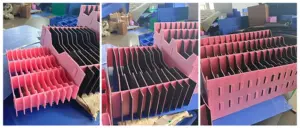
Cardboard Is Disposable, While PP Corrugated Packaging Is Reusable
One important difference is often overlooked. Cardboard boxes are generally disposable consumables, while PP corrugated boards can serve as reusable assets.
Ordinary corrugated cardboard boxes may deform after transportation, loading, moisture exposure, or stacking pressure. Many survive only one to three uses. During rainy seasons, warehouses may experience damp conditions. Cardboard boxes can soften, collapse, or become damaged.
Workers must then purchase replacements, repack products, return damaged packaging, and handle discarded materials. These activities create labor costs that rarely appear on the original packaging quotation.
PP corrugated boards behave differently. Polypropylene materials resist water and moisture while offering impact resistance. They are also less likely to tear or deform. Under normal conditions, PP corrugated turnover boxes and dividers can withstand repeated use.
Even after cleaning, these containers can return to service. Their stacking strength remains relatively stable under suitable operating conditions. When calculated per use, PP corrugated packaging can cost less than cardboard packaging.
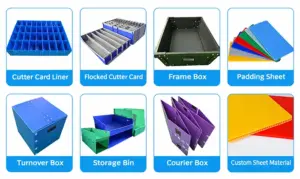
Hidden Value Beyond Packaging Material Costs
Direct packaging material expenses represent only part of the total cost. Other benefits deserve attention.
Reduce Product Damage During Transportation
Precision components, electronic devices, and new energy parts are vulnerable to collisions and electrostatic damage during transportation. Ordinary cardboard does not provide specialized antistatic protection. Paper fibers may also adhere to product surfaces and cause quality defects.
Customized antistatic PP corrugated boards and dividers can address these challenges. Each product can fit securely into an individual compartment. This arrangement reduces movement and friction during transportation, lowering the risk of product damage.
In many cases, the losses caused by damaged products exceed the cost of the packaging itself.
Improve Warehouse Management and Space Efficiency
PP corrugated turnover boxes can also improve warehouse operations. Foldable designs allow empty containers to be stored compactly during return transportation. Uniform box dimensions support stable stacking and organized warehouse management.
Companies can also print corporate logos and other identification details on their packaging. This creates a more consistent appearance throughout the supply chain.
After reaching the end of their service life, PP boards can be recycled through suitable collection channels. This supports circular packaging practices and helps reduce pressure on solid waste disposal systems.
[Image 3: Product gallery showing compartment inserts, reinforced dividers, framework boxes, layer pads, turnover boxes, storage bins, shipping boxes, and customized PP corrugated sheets]
When Should Businesses Choose PP Corrugated Packaging?
Not every packaging application requires PP corrugated boards. Cardboard remains a practical choice for many situations.
For disposable external packaging, short-distance transportation, or one-way shipments, cardboard boxes may be more economical.
PP corrugated boards are more suitable for internal factory turnover, repeated distribution between facilities, and multiple handling cycles. They also perform well in humid environments and applications requiring precision component protection. Businesses seeking stable long-term packaging solutions should consider reusable PP packaging.
How to Compare the Total Cost of Packaging
Packaging selection should depend on actual operating conditions rather than purchase price alone. Cardboard reduces initial spending but may create recurring expenses through replacement, damage, returns, and repeated purchasing.
PP corrugated packaging requires a higher initial investment. However, its reusable structure, stable protection, and controllable long-term costs can deliver better value.
The most suitable choice depends on shipment frequency, packaging lifespan, product sensitivity, and logistics requirements.
Custom PP Corrugated Packaging Solutions from PremierPlast
PremierPlast operates a PP corrugated board manufacturing facility in Huizhou, Guangdong Province. With its own production lines, the company manufactures customized PP corrugated sheets, turnover boxes, dividers, and compartment inserts.
Available options include antistatic designs, different thicknesses, and various colors. Free samples are also available.
PremierPlast does more than manufacture plastic sheets and boxes. Its team evaluates products, warehousing conditions, and transportation processes to calculate packaging costs throughout the entire lifecycle. This approach helps customers determine whether reusable packaging suits their production operations.
Conclusion
The true value of packaging extends beyond the price of a single box. Effective packaging protects products, simplifies supply chains, and reduces unnecessary losses.
Although PP corrugated packaging may cost more initially, repeated use can reduce long-term expenses. Businesses should evaluate packaging durability, product protection, labor requirements, and logistics efficiency before making purchasing decisions.
Choosing the right packaging solution means balancing upfront investment with long-term operational value.