


Yes. PP layer pads can be customized for automated palletizing and depalletizing systems, including robotic palletizers, gantry palletizers, automatic layer-pad dispensers, and high-speed beverage packaging lines.
However, customization involves more than adjusting sheet dimensions. Automated systems require consistent material thickness, flatness, stiffness, surface friction, and reliable sheet separation to maintain smooth operation.
Poorly designed layer pads can cause double-sheet feeding, vacuum pickup failures, conveyor jams, unstable pallet loads, and unexpected production downtime.
For manufacturers and packaging engineers, selecting the right PP layer pad requires evaluating both the material properties and the mechanical requirements of the automated equipment.
This guide explains the key customization options, engineering considerations, and testing procedures for integrating PP layer pads into automated palletizing systems.
1. How PP Layer Pads Work in Automated Palletizing Systems
PP layer pads, also called polypropylene pallet separator sheets, are placed between product layers to improve load stability and protect products during palletizing, transportation, and storage.
In automated packaging lines, layer pads may be handled by vacuum suction systems, mechanical grippers, robotic arms, or dedicated dispensing equipment.
A typical automated palletizing process includes:
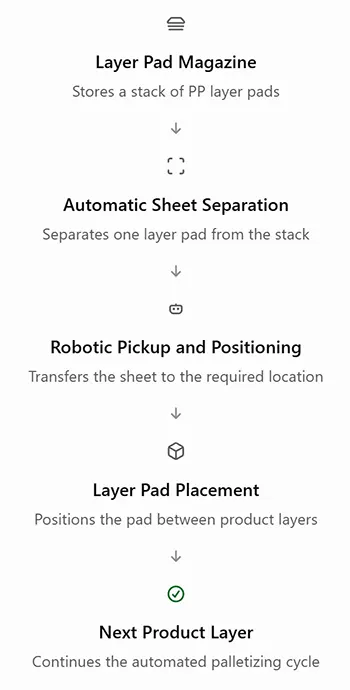
The entire process depends on repeatable sheet handling. Even small variations in dimensions, stiffness, or surface characteristics can affect equipment performance, particularly at high operating speeds.
2. What Can Be Customized for Automated Palletizing?
PP layer pads can be manufactured with different dimensions, thicknesses, material formulations, surface properties, and edge configurations.
The following table summarizes common customization options.
| Customization Item | Available Options | Engineering Purpose |
|---|---|---|
| Length and width | Custom-cut dimensions | Match pallet and product-layer geometry |
| Thickness | Commonly 2–5 mm, with other options available | Balance stiffness, weight, and handling |
| Material structure | Corrugated PP or solid PP | Adjust rigidity, weight, and surface support |
| Sheet flatness | Controlled during production and storage | Improve vacuum pickup and positioning |
| Surface texture | Smooth, matte, or textured | Adjust friction and sheet separation |
| Color | White, black, blue, or custom | Product identification and visual detection |
| Edge design | Straight, rounded, or chamfered corners | Reduce snagging and handling damage |
| Antistatic properties | Formulated antistatic or conductive PP | Support ESD-sensitive applications |
| Surface cleanliness | Application-specific cleanliness controls | Reduce contamination risks |
| Packaging configuration | Aligned stacks, controlled orientation | Support automatic sheet dispensing |
Available specifications depend on the manufacturing process, sheet construction, and application requirements. Final values should be confirmed through samples and machine trials.
3. Critical Engineering Requirements for Automated Palletizing
3.1 Dimensional Accuracy and Repeatability
Automated layer-pad dispensers operate within defined positioning and clearance limits.
If sheet dimensions vary significantly, the equipment may experience misalignment, mechanical interference, or inconsistent placement.
For example, a layer pad that is slightly oversized may catch on the dispenser guides. An undersized sheet may fail to provide sufficient support for the product layer.
Manufacturers should therefore control:
Length and width tolerances.
Squareness and edge straightness.
Consistency between production batches.
Cutting burrs and dimensional distortion.
Professional recommendation: Do not specify a universal dimensional tolerance without reviewing the equipment. The acceptable tolerance should be determined by the dispenser’s guide clearance, positioning accuracy, and product-layer geometry.
3.2 Flatness and Warpage Control
Flatness is one of the most important properties of PP layer pads used in automatic feeding systems.
Warped sheets can prevent vacuum suction cups from sealing correctly. They may also cause uneven placement, sheet jams, or instability between product layers.
Several factors influence PP sheet flatness, including extrusion cooling conditions, internal residual stress, sheet thickness, storage temperature, and stacking methods.
Manufacturers can improve flatness consistency through controlled extrusion, balanced cooling, proper cutting, and flat storage.
For demanding applications, flatness should be measured using an agreed inspection method rather than evaluated only by visual appearance.
3.3 Thickness and Bending Stiffness
PP layer pads must be rigid enough for reliable handling while remaining lightweight and economical.
Insufficient stiffness may cause sheets to sag during robotic transfer. Excessive rigidity or thickness may increase material consumption and interfere with equipment designed for thinner pads.
Corrugated PP sheets provide bending stiffness through their internal rib structure, while solid PP sheets offer a more uniform cross-section.
Corrugated PP Layer Pads
Lightweight structure with stiffness influenced by rib geometry and orientation.
Solid PP Layer Pads
Uniform solid structure suitable for applications requiring continuous surface support.
When selecting thickness, engineers should consider the pad’s unsupported span, pickup-point locations, acceleration during transfer, product weight, and pallet load distribution.
For corrugated PP, rib direction should also be evaluated because bending stiffness can vary with orientation.
3.4 Surface Friction and Sheet Separation
The surface coefficient of friction affects both automated handling and pallet stability.
If friction between adjacent layer pads is too high, sheets may stick together during dispensing. If friction between the layer pad and products is too low, the pallet load may become less stable.
These requirements can conflict.
For example, a low-friction surface may improve sheet separation but reduce resistance to product movement during transportation.
Therefore, surface properties should be optimized for the complete system rather than for sheet dispensing alone.
Surface finish, formulation, contamination, humidity, and the contact materials can all influence friction behavior.
3.5 Compatibility With Vacuum Suction Systems
Vacuum suction is commonly used to lift and position layer pads in automated equipment.
Successful vacuum handling depends on the interaction between the suction cups and the sheet surface.
Important factors include surface roughness, local flatness, sheet permeability, suction-cup diameter, vacuum level, and pickup-point distribution.
Corrugated PP layer pads may have local surface flexibility between internal ribs. This can influence suction-cup sealing and sheet deformation during pickup.
For high-speed equipment, engineers should also evaluate whether the pad remains stable during acceleration and deceleration.
Professional recommendation: Conduct actual vacuum pickup trials using the intended suction cups, operating speed, and sheet specifications. A successful static lifting test does not guarantee reliable operation at full production speed.
4. Choosing Between Corrugated PP and Solid PP Layer Pads
Both materials can be used in automated palletizing systems, but their suitability depends on the handling equipment and product requirements.
| Comparison | Corrugated PP | Solid PP |
|---|---|---|
| Structure | Hollow, ribbed | Uniform solid |
| Weight efficiency | Often favorable | Depends on selected thickness |
| Bending stiffness | Direction-dependent | More uniform in-plane |
| Surface support | Supported by skins and internal ribs | Continuous solid structure |
| Vacuum pickup | Requires evaluation of local flexibility | Depends on surface and thickness |
| Cleaning | Exposed flute edges may retain contaminants | Generally easier to clean |
| Reusability | Good with suitable design | Good with suitable design |
| Material cost | Depends on thickness and weight | Depends on thickness and weight |
| Typical suitability | Lightweight layer separation | Applications requiring solid construction |
Neither material is universally better.
For high-speed beverage palletizing, corrugated PP may provide an attractive balance of weight and stiffness. However, a solid PP design may be preferable where continuous surface support, cleaning requirements, or particular handling characteristics are more important.
The final selection should be based on machine testing and total operating cost.
5. Custom PP Layer Pads for Different Automated Packaging Applications
Beverage Cans and Bottles
High-speed palletizing lines require consistent pad dimensions, flatness, and reliable automatic dispensing. Layer pads must also support stable product stacking.
Glass Containers
Layer pads must distribute loads appropriately and provide suitable friction characteristics to help reduce product movement and breakage.
Cartons and Industrial Packaging
Custom dimensions and surface properties can improve compatibility with robotic palletizers and different carton arrangements.
Electronics and ESD-Sensitive Products
Antistatic or conductive formulations may be required to meet specified electrostatic protection standards and handling requirements.
6. Common Problems in Automated Layer Pad Handling
| Problem | Possible Cause | Recommended Solution |
|---|---|---|
| Double-sheet feeding | Excessive inter-sheet adhesion or static | Optimize surface properties and sheet separation |
| Vacuum pickup failure | Warpage, leakage, or unsuitable suction arrangement | Improve flatness and validate suction-cup design |
| Sheet misalignment | Dimensional variation or positioning errors | Improve cutting consistency and dispenser setup |
| Sheets bending during transfer | Insufficient stiffness or unsupported span | Adjust structure, thickness, or pickup locations |
| Conveyor or dispenser jams | Oversized sheets, burrs, or warped edges | Control dimensions, edge quality, and flatness |
| Unstable pallet loads | Insufficient friction or inadequate layer support | Evaluate surface properties and load distribution |
| High rejection rates | Inconsistent material or production batches | Establish inspection criteria and process controls |
Not every problem originates from the layer pad. Vacuum-system maintenance, sensor positioning, robot programming, and equipment alignment should also be investigated.
7. How to Test Customized PP Layer Pads Before Mass Production
A professional supplier should recommend sample testing before committing to large-scale production.
The validation process should include material inspection, mechanical evaluation, and actual machine trials.
Define equipment requirements
Collect pallet dimensions, layer-pad magazine dimensions, pickup methods, operating speed, product weight, and environmental conditions.
Develop sample specifications
Select the PP sheet structure, thickness, surface finish, dimensions, and edge design.
Perform laboratory inspection
Measure dimensions, flatness, thickness, stiffness, and other agreed material properties.
Conduct automated equipment trials
Test sheet separation, vacuum pickup, positioning, and full-speed operation under representative production conditions.
Evaluate pallet stability
Assess stacking performance, product movement, and transportation-related risks where relevant.
Approve the final specification
Document acceptable tolerances, inspection methods, packaging configuration, and quality requirements for repeat orders.
What Performance Indicators Should Be Monitored?
For automated equipment trials, useful indicators include successful single-sheet pickup rate, double-feed frequency, misalignment events, cycle-time consistency, and equipment stoppages.
The acceptable values should be agreed upon by the packaging equipment operator and layer-pad supplier.
A short trial may identify obvious problems, but longer production trials can reveal issues related to stack height, batch variation, static buildup, or temperature changes.
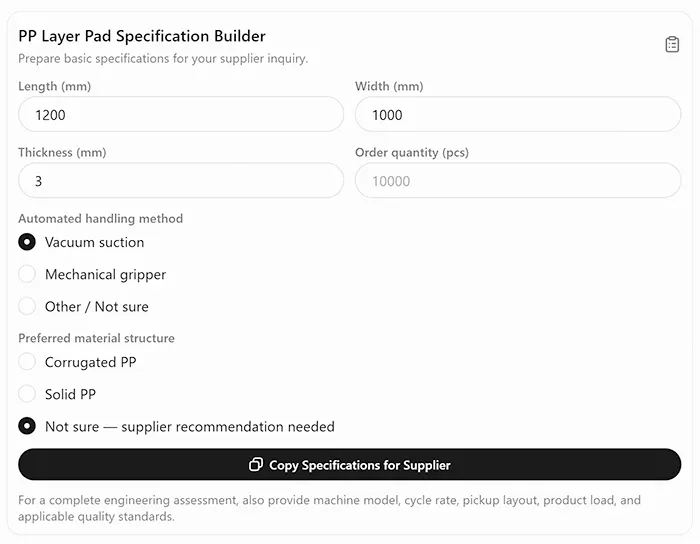
8. What Information Should Buyers Provide for Custom PP Layer Pads?
When requesting a quotation, buyers should provide sufficient technical information to evaluate both manufacturing feasibility and equipment compatibility.
9. How Premierplast Supports Customized PP Layer Pad Projects
Premierplast is a Shenzhen-based manufacturer established in 2005, specializing in PP corrugated sheets and customized polypropylene packaging products.
For automated palletizing applications, the selection of PP layer pads should begin with the customer’s equipment and product-handling requirements.
Important considerations include material selection, sheet dimensions, stiffness, surface characteristics, cutting quality, and packaging configuration.
By evaluating these factors during product development, manufacturers and customers can identify suitable layer-pad specifications before mass production.
For projects involving robotic handling or automatic sheet dispensing, sample evaluation and equipment trials are particularly important.
10. Frequently Asked Questions
Can PP layer pads be used in high-speed robotic palletizing systems?
Yes. Properly designed PP layer pads can be used in high-speed robotic palletizing systems. Their suitability depends on sheet flatness, stiffness, surface characteristics, pickup design, and operating speed.
What thickness is best for automated palletizing?
There is no universal thickness. Common options include 2–5 mm, but the appropriate thickness depends on sheet construction, product weight, unsupported span, and automated handling requirements.
Can PP layer pads be customized for vacuum suction pickup?
Yes. Manufacturers can adjust sheet thickness, surface characteristics, flatness, and other specifications to improve compatibility with vacuum suction equipment. Actual machine testing remains necessary.
Are antistatic PP layer pads available for automated packaging?
Antistatic or conductive PP formulations can be used for applications requiring electrostatic control. Buyers should specify the required electrical performance and applicable test standards.
Can customized PP layer pads be reused in automated systems?
Yes. Reuse is possible when the material and design withstand repeated handling, cleaning, and loading. Reusable pads should be periodically inspected for deformation, cracks, contamination, and wear.
Can PP layer pads be customized for different pallet sizes?
Yes. They can be cut to suit common pallet footprints and custom dimensions. The final size should account for product arrangement, pallet geometry, equipment clearance, and allowable overhang.
Conclusion
PP layer pads can be customized to meet the requirements of automated palletizing and depalletizing systems.
However, successful integration requires more than selecting the correct sheet size. Material stiffness, flatness, surface friction, dimensional consistency, and vacuum pickup performance all influence equipment reliability.
For high-speed packaging operations, a well-designed PP layer pad can help improve handling consistency, reduce avoidable interruptions, and support stable pallet loads.
Looking for custom PP layer pads for your automated palletizing system?
Contact Premierplast with your equipment specifications, pallet dimensions, product requirements, and expected order quantity. Our team can discuss suitable PP layer pad options and sample requirements for your packaging application.