


PP layer pads, also known as polypropylene layer pads or plastic pallet separator sheets, are widely used in beverage, food, pharmaceutical, and industrial packaging. Their lightweight construction, moisture resistance, and reusable properties make them suitable for international supply chains.
However, proper packaging is essential to ensure PP layer pads arrive flat, clean, undamaged, and ready for use. Poor packaging can cause bent corners, warped sheets, surface scratches, contamination, and unnecessary freight costs.
For international buyers, choosing the right packaging method involves more than protecting the products. Manufacturers must also consider pallet dimensions, stacking height, container utilization, unloading methods, and destination-country import requirements.
This guide explains common export packaging methods, professional loading practices, and key considerations for shipping PP layer pads internationally.
1. Common Packaging Methods for PP Layer Pads
Different packaging methods are suitable for different pad dimensions, thicknesses, quantities, and shipping requirements.
1. Palletized Packaging
PP layer pads are stacked flat on pallets and secured with PET or PP straps, stretch film, and protective corner boards.
Best for: Large-volume orders, sea freight, and forklift handling.
2. Carton Packaging
Smaller quantities of PP layer pads are placed inside corrugated cartons with protective liners.
Best for: Samples, smaller sheets, and low-volume orders.
3. Stretch-Film Wrapping
Stacked pads are wrapped with polyethylene stretch film to reduce dust exposure and prevent movement.
Best for: Standard-sized pads requiring economical protection. A rigid base and strapping may still be necessary.
4. Wooden Crate or Reinforced Packaging
Oversized, precision-cut, or high-value layer pads can be packed in reinforced plywood crates or rigid protective frames.
Best for: Special dimensions, sensitive surfaces, and shipments requiring additional handling protection.
For most commercial export orders, palletized packaging with protective sheets, corner protection, strapping, and stretch film offers a practical balance between protection, handling efficiency, and cost.
2. How Manufacturers Prepare PP Layer Pads for Export
A reliable export packaging process begins before the layer pads are loaded onto pallets.
Step 1: Product Inspection and Cleaning
Before packaging, manufacturers should inspect the PP layer pads for dimensional accuracy, flatness, surface condition, and edge quality.
Key inspection points include:
- Length, width, thickness, and dimensional tolerances.
- Flatness and visible warpage.
- Burrs, sharp edges, and cutting defects.
- Scratches, dents, and surface contamination.
- Color consistency and special requirements, such as antistatic or conductive properties.
Clean, dry sheets should be packaged in a controlled area to minimize dust and foreign-material contamination.
Step 2: Flat Stacking and Alignment
PP layer pads should generally be stacked horizontally on a clean, flat, sufficiently rigid surface.
All sheets must be properly aligned to avoid uneven pressure distribution. Unsupported edges and excessive overhang can lead to deformation during transportation.
For large-format or thin PP layer pads, manufacturers should consider additional bottom support and intermediate rigid sheets.
Step 3: Corner and Surface Protection
Protective corner boards help distribute strapping pressure and reduce the risk of edge damage.
Depending on the product, packaging may include:
- Cardboard or plastic corner protectors.
- Top and bottom protective boards.
- PE film or clean interleaving sheets.
- Rigid supports for large-format products.
Protective materials should not introduce particles, marks, or contamination onto the product surface.
Step 4: Strapping and Stretch Wrapping
PET or PP straps secure the stacked layer pads to the pallet. Stretch film provides additional containment and helps limit dust exposure.
Strapping tension must be controlled carefully. Excessive tension can create localized pressure, particularly on thin or flexible sheets.
Stretch film should not be treated as a substitute for structural restraint when the load is heavy or unstable.
Step 5: Labeling and Final Inspection
Each export package should carry clear identification, including product name, dimensions, quantity, batch or lot number, gross weight, and shipping marks where required.
Before shipment, the manufacturer should confirm that the package is stable, properly secured, and suitable for the intended handling method.
3. Export Packaging Specifications for PP Layer Pads
The following table illustrates typical packaging options. Actual quantities and pallet configurations depend on pad thickness, dimensions, density, and the transport system.
| Packaging Item | Common Export Practice |
|---|---|
| Packaging type | Flat stacking, palletized, carton, or crate |
| Pallet material | Plastic, plywood, or compliant solid wood |
| Protective material | PE film, protective boards, corner guards |
| Securing method | PET/PP strapping and stretch film |
| Stack height | Determined by load stability and product compression limits |
| Quantity per pallet | Calculated from sheet size, thickness, and safe load capacity |
| Shipping method | Sea freight, air freight, or courier |
| Identification | Product dimensions, quantity, lot number, shipping marks |
These are general packaging practices, not universal shipping specifications. Final configurations should be validated for each order.
4. How Are PP Layer Pads Loaded into Shipping Containers?
Container loading is one of the most important considerations when exporting PP layer pads, especially for high-volume shipments.
Because PP layer pads are relatively lightweight but can occupy substantial space, shipping costs are often influenced by cargo volume rather than weight alone.
20-Foot vs. 40-Foot Containers
| Container Type | Approx. Internal Dimensions (L × W × H) | Typical Application |
|---|---|---|
| 20ft GP | 5.90 × 2.35 × 2.39 m | Smaller export shipments |
| 40ft GP | 12.03 × 2.35 × 2.39 m | Larger orders |
| 40ft HC | 12.03 × 2.35 × 2.69 m | Higher-volume cargo where extra height is useful |
Dimensions are indicative and vary by container manufacturer. Door openings, usable loading space, payload limits, and pallet configurations must also be checked.
Professional Container Loading Considerations
Maximize space utilization. Manufacturers should calculate the loaded pallet footprint and height before selecting the container type. Custom pallet configurations may improve container utilization.
Prevent cargo movement. Pallets should be secured using appropriate blocking, bracing, or other cargo-restraint methods. Strapping individual pallets does not eliminate the need to secure the cargo inside the container.
Control moisture exposure. Although polypropylene resists moisture absorption, condensation can damage cartons, labels, and wooden packaging. A dry container, suitable protective wrapping, and appropriate moisture-control measures help reduce these risks.
Avoid excessive stacking pressure. Thin PP layer pads may deform under concentrated or prolonged loads. Double-stacking pallets should only be considered when the packaging structure and load capacity have been verified.
5. How to Reduce International Shipping Costs
Packaging design directly affects the landed cost of PP layer pads. Manufacturers and buyers can work together to reduce freight expenses without compromising product quality.
Optimize pallet dimensions
Select pallet footprints that match both the layer pad dimensions and container loading layout, while minimizing unsupported overhang.
Optimize stacking quantity
Calculate the maximum safe number of sheets per pallet based on thickness, load capacity, deformation risk, and handling requirements.
Choose the right container
Compare 20ft, 40ft, and 40ft HC options using the actual number of loaded pallets, total freight cost, and destination handling conditions.
Consider reusable packaging
For repeat shipments, reusable plastic pallets and returnable transport packaging may reduce long-term packaging waste and costs when reverse logistics are practical.
Example: Calculating the Quantity of PP Layer Pads per Pallet
Consider a hypothetical order with the following specifications:
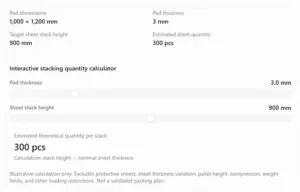
A higher stacking quantity may reduce the number of pallets needed. However, the manufacturer must verify that the stack can be transported without excessive compression, warpage, or instability.
6. International Shipping Requirements and Documentation
Export packaging must satisfy the requirements of the destination market, carrier, and importing customer.
ISPM 15 and Wooden Packaging
Solid wood pallets and wooden dunnage used in international shipments may be subject to ISPM 15 phytosanitary requirements, depending on the destination.
Where applicable, wood packaging must be appropriately treated and marked. Processed-wood products such as qualifying plywood are generally exempt from ISPM 15 treatment requirements.
Plastic pallets can help avoid wood-packaging phytosanitary requirements, although they still need to meet the shipment’s mechanical and handling requirements.
Export Documentation
Common shipping documents include:
- Commercial invoice.
- Packing list detailing quantity, packages, dimensions, and weights.
- Bill of lading or air waybill.
- Certificate of origin, when required.
- Customs documentation and any destination-specific declarations.
The applicable HS classification should be confirmed based on the product’s actual form, characteristics, and use. Not all PP layer pads necessarily fall under the same customs classification.
Special Requirements for Food and ESD Applications
For food-industry applications, buyers may require evidence that the materials are suitable for their intended food-contact conditions, where direct food contact is involved.
For ESD-sensitive applications, packaging must also preserve the required electrostatic properties. Ordinary plastic wrapping should not automatically be considered suitable for ESD-protective products.
7. Common Shipping Problems and How to Prevent Them
| Shipping Problem | Possible Cause | Preventive Measure |
|---|---|---|
| Bent corners | Improper handling or excessive strapping tension | Use corner protectors and control tension |
| Warped sheets | Uneven support, excessive loading, or heat exposure | Maintain flat support and verify stacking limits |
| Surface scratches | Friction or particles between sheets | Use clean handling and protective interleaving |
| Unstable pallets | Poor alignment or inadequate restraint | Align stacks and validate securing methods |
| Moisture-damaged cartons | Container condensation or water exposure | Use dry containers and suitable moisture protection |
| Higher freight costs | Poor pallet utilization or oversized packaging | Optimize the pallet and container loading plan |
| Customs or inspection delays | Incomplete documentation or noncompliant wood packaging | Verify documents and destination requirements before shipment |
8. How Premierplast Supports International PP Layer Pad Orders
As a Shenzhen-based manufacturer established in 2005, Premierplast specializes in polypropylene corrugated sheets and customized plastic packaging solutions.
For international PP layer pad projects, packaging should be considered during the quotation and order-planning stages rather than after production is completed.
Key factors to review with customers include product dimensions, thickness, order quantity, pallet preferences, shipping destination, and unloading equipment.
An effective export packaging plan should achieve three objectives: protect product quality, improve logistics efficiency, and control the total delivered cost.
By coordinating product specifications with packaging and transportation requirements, manufacturers can help overseas customers establish more reliable supply chains.
9. Frequently Asked Questions About PP Layer Pad Export Packaging
Can PP layer pads be shipped without wooden pallets?
Yes. Plastic pallets, suitable plywood pallets, or other engineered packaging solutions may be used. The choice depends on shipment size, handling requirements, and destination regulations.
How many PP layer pads can fit into a 40ft container?
There is no fixed quantity. Capacity depends on sheet dimensions, thickness, density, pallet configuration, stack height, and container loading restrictions. A loading calculation should be completed for each order.
Are PP layer pads waterproof during shipping?
Polypropylene is highly resistant to moisture, but this does not make the entire shipping package waterproof. Protective wrapping and proper container conditions remain important.
Can PP layer pads be folded or rolled to save shipping space?
Flat shipping is generally preferred. Folding or rolling may cause permanent deformation, creasing, or dimensional changes, especially with rigid or thick pads. Alternative packing methods should only be used after product-specific validation.
Is sea freight suitable for PP layer pads?
Yes. Sea freight is commonly suitable for large-volume shipments because it can provide a lower transportation cost per unit than air freight. Proper palletization and container loading remain essential.
What information should buyers provide before ordering?
Buyers should provide the required length, width, thickness, material grade, quantity, destination, and packaging preferences. Special requirements such as food-contact suitability, ESD properties, and automated depalletizing compatibility should also be communicated.
Conclusion
Proper export packaging plays a critical role in maintaining the quality of PP layer pads throughout international transportation.
From flat stacking and corner protection to pallet design and container optimization, every packaging decision can influence product condition, logistics efficiency, and landed cost.
For international buyers, working with a manufacturer that considers packaging requirements early in the production process can help reduce damage, avoid unnecessary freight expenses, and improve delivery reliability.
Looking for customized PP layer pads for international shipping?
Contact Premierplast to discuss your PP layer pad dimensions, materials, order quantities, and export packaging requirements. Our team can help evaluate suitable manufacturing and packaging options for your application.