


With China’s continued economic growth and improving logistics systems, the consumption of packaging materials has increased significantly. Degradable and recyclable packaging materials have therefore attracted growing industry attention.
Corrugated board is widely used in packaging because of its low cost and good cushioning performance. However, moisture can easily damage it in humid environments.
Its low recycling rate and poor moisture resistance also limit wider applications. Polypropylene (PP), a typical semi-crystalline plastic, offers low weight, moisture resistance, and excellent heat resistance.
PP corrugated sheet shows potential to replace traditional corrugated board in transport packaging. It is already used across agriculture, chemicals, construction, and engineering manufacturing.
Bending performance is a key indicator of material load-bearing capacity. It directly affects the suitability of PP corrugated sheet for transport packaging.
Previous studies have investigated the structural, stiffness, and strength properties of related materials. Researchers have also developed finite element models to evaluate material damage under different impact conditions.
Other studies examined corrugated board and honeycomb board through static compression testing. Results provided useful references for developing new packaging boards.
Researchers also produced hollow polymer specimens using stereolithography 3D printing. Bending strength and stiffness tests showed that improved structures significantly enhanced bending performance.
Finite element simulations have also predicted the compression performance of corrugated board. These methods reduced solution time and memory consumption while supporting structural analysis.
Existing research still lacks dedicated studies on PP corrugated sheet. Two important research gaps remain in its structural design for packaging applications.
First, the coupling effect between thickness and core layer spacing remains insufficiently studied. Second, accurate prediction models for thin PP corrugated sheet used in packaging remain limited.
This study investigates bending performance through theoretical analysis, experimental verification, and simulation. It considers different combinations of sheet thickness and core layer spacing.
A bending moment of inertia equation incorporates corrections for core layer spacing. Three-point bending data support finite element modeling and expanded parameter analysis.
The model provides accurate data and a practical tool for packaging structure optimization. It can also support PP corrugated sheet applications in green packaging.
Theoretical Analysis of PP Corrugated Sheet
Structural Characteristics
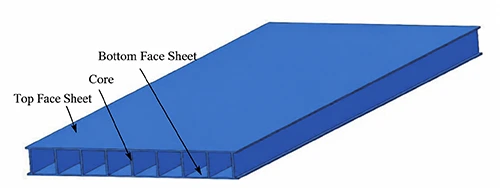
PP corrugated sheet for packaging is a lightweight and multifunctional plastic material. Mainstream market thicknesses include 3, 4, and 5 mm.
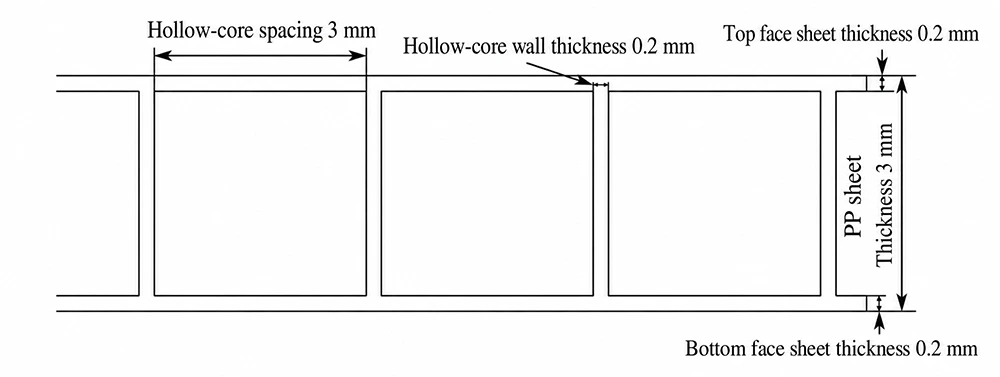
Its typical structure consists of upper and lower face sheets with an intermediate core layer. Both face sheets have a thickness of 0.2 mm.
The core layer is also 0.2 mm thick, while the core layer spacing is 3 mm.
[Image 1: Structural Diagram of PP Corrugated Sheet]
Bending Moment of Inertia
Under small deformation, material stress and strain maintain a linear relationship according to Hooke’s law. The cross-section remains planar during bending deformation.
The bending moment of inertia mainly comes from the upper and lower face sheets. Effective density can correct the contribution from the intermediate core layer.
> Face Sheet Cross-Sectional Area
The face sheet cross-sectional area depends on its width and thickness. The cross-sectional area of one face sheet is calculated as follows.

Here, b represents the sheet width in millimeters. The variable hface represents the single face sheet thickness of 0.2 mm.
> Moment of Inertia Calculation
Core column spacing influences the moment of inertia. Effective density across the width can correct this influence.


Here, h represents the corrugated sheet thickness in millimeters. The variable d represents the distance between the center planes of both face sheets.
> Total Moment of Inertia
The total moment of inertia is calculated using the structural parameters. In this calculation, s represents the core layer spacing in millimeters.

The core columns contribute far less inertia than the face sheets. Their moment of inertia can therefore be neglected.

> Maximum Bending Force Prediction
Classical beam bending theory predicts the maximum bending force. The calculation also incorporates the bending moment generated during three-point loading.



In these equations, the variables represent PP bending strength, maximum bending moment, neutral-axis distance, and support span.
The bending performance of PP corrugated sheet depends on its total sectional moment of inertia. Increasing sheet thickness increases this value and improves bending load capacity.
Increasing core layer spacing produces the opposite effect. Wider spacing reduces effective core column density, decreasing total inertia and bending resistance.
These relationships explain how structural parameters affect bending performance. They also establish the theoretical basis for experiments and finite element simulations.
Experiment
Experimental Equipment and Materials
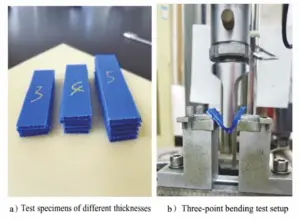
The main equipment included a constant-temperature and humidity chamber and a universal testing machine. Specimen orientation and dimensions were carefully controlled during preparation.
This approach maintained structural uniformity and improved test reliability. PP corrugated sheet specimens had different thicknesses but identical core layer spacing.
Each specimen measured 80 mm × 25 mm.
| Sample | Basis Weight (g/m²) | Sample Thickness (mm) | Face Sheet Thickness (mm) |
|---|---|---|---|
| A | 584.76 | 3 | 0.2 |
| B | 696.83 | 4 | 0.2 |
| C | 934.92 | 5 | 0.2 |
Table 1. Parameters of PP Corrugated Sheet Experimental Samples
Temperature and Humidity Conditioning
Environmental conditions can affect the mechanical properties of packaging materials. Therefore, all specimens underwent 24 hours of conditioning in a controlled chamber.
The chamber temperature was maintained at 23°C with 50% relative humidity. This treatment reduced environmental influences on the subsequent mechanical tests.
Three-Point Bending Test
Three-point bending tests simulated the bending loads encountered during actual use. Both specimen ends rested on fixed supports during testing.
A constant vertical displacement load was applied at the specimen midpoint. The test measured bending strength and bending modulus.
Key parameters included a 64 mm span, 4 mm/s loading speed, and 25 mm specimen width. These parameters followed the relevant testing standards.
> Specimen Measurement
A micrometer or vernier caliper measured specimen thickness, width, and length. All measured dimensions were recorded before testing.
> Specimen Installation
The three-point bending fixture was installed on the universal testing machine. The span was adjusted before positioning each specimen securely.
The specimen midpoint was aligned with the loading head.
> Parameter Settings
Test parameters were configured according to the applicable standards and specimen dimensions. These included bending speed, length, width, and span.
> Testing
Specimens with thicknesses of 3, 4, and 5 mm underwent separate tests. Five specimens were tested for each thickness.
Abnormal values were excluded before calculating the average. The resulting data provided the material’s mechanical performance parameters.
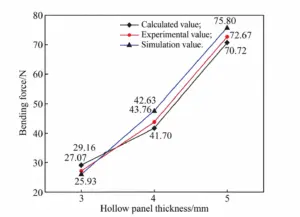
The average bending force increased from 27.07 N to 72.67 N as thickness increased from 3 mm to 5 mm. This represents a 168.5% increase.
The bending modulus initially increased before approaching stability. Average values reached 1540.49 MPa at 4 mm and 1647.03 MPa at 5 mm.
Variation coefficients remained below 8% across all test groups. This low dispersion indicates good reliability of the experimental data.
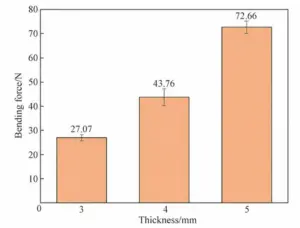
Increasing thickness significantly increased the face sheet moment of inertia at fixed core spacing. This structural change improved the bending performance of PP corrugated sheet.
The bending modulus approached saturation at 4 mm thickness. This thickness may therefore represent a threshold for further structural stiffness improvement.
The measured average bending strength also provides material parameters for finite element models. These values support subsequent simulation validation.
Finite Element Analysis
This study follows an experiment-first and simulation-second approach. Three-point bending tests first provided mechanical data for 3, 4, and 5 mm specimens.
The measured parameters included bending force, bending modulus, and bending strength. These experimental values provided realistic material parameters for finite element modeling.
The simulation then verified models with different thicknesses under identical core layer spacing. The analysis expanded core spacing to 2, 3, and 4 mm.
This approach addresses the experimental limitation of testing only one core layer spacing. Stress contours also identify critical bending failure regions near the sheet center.
Combining experiments with simulations improves the reliability and practical value of the research. It also provides guidance for subsequent structural optimization.
Simulation of PP Corrugated Sheet with Different Thicknesses
> Simulation Model Development
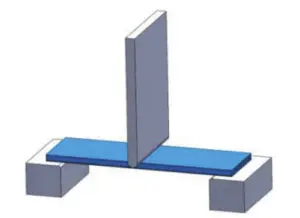
Three finite element models were created according to the experimental specimen dimensions. Each PP corrugated sheet model had a different overall thickness.
Upper and lower face sheets were 0.2 mm thick. The intermediate core layer was also 0.2 mm thick with 3 mm spacing.
The overall sheet thicknesses were 3, 4, and 5 mm. Other structural parameters remained unchanged across the three models.
| Corrugated Sheet | Length × Width × Height (mm) | Core Layer Spacing (mm) |
|---|---|---|
| A | 80 × 25 × 3 | 3 |
| B | 80 × 25 × 4 | 3 |
| C | 80 × 25 × 5 | 3 |
Table 3. PP Corrugated Sheet Simulation Structure Parameters
> Simulation and Result Analysis
A polypropylene corrugated sheet material was defined in ANSYS. Its parameters included density, elastic modulus, Poisson’s ratio, yield strength, and tangent modulus.
| Density (kg/m³) | Elastic Modulus (MPa) | Poisson’s Ratio | Yield Strength (MPa) | Tangent Modulus (MPa) |
|---|---|---|---|---|
| 185 | 1800 | 0.35 | 20 | 1500 |
Table 4. Simulation Material Parameters of PP Corrugated Sheet
The PP corrugated sheet model was imported into the transient dynamic analysis module. Mid-surface extraction was completed in SpaceClaim before transferring geometry into Workbench.
Structural steel was assigned to the supports and loading head. Defined PP material properties were assigned to the corrugated sheet.
The global mesh size was 2 mm, while the local corrugated sheet mesh size was 0.5 mm. Hexahedral-dominant meshing improved calculation accuracy in critical regions.
The contact mode used friction with a coefficient of 0.2. Fixed constraints were applied to the support bases.
A loading head with a 2 mm radius moved at 4 mm/s along the y-axis. The resulting force response was then calculated.
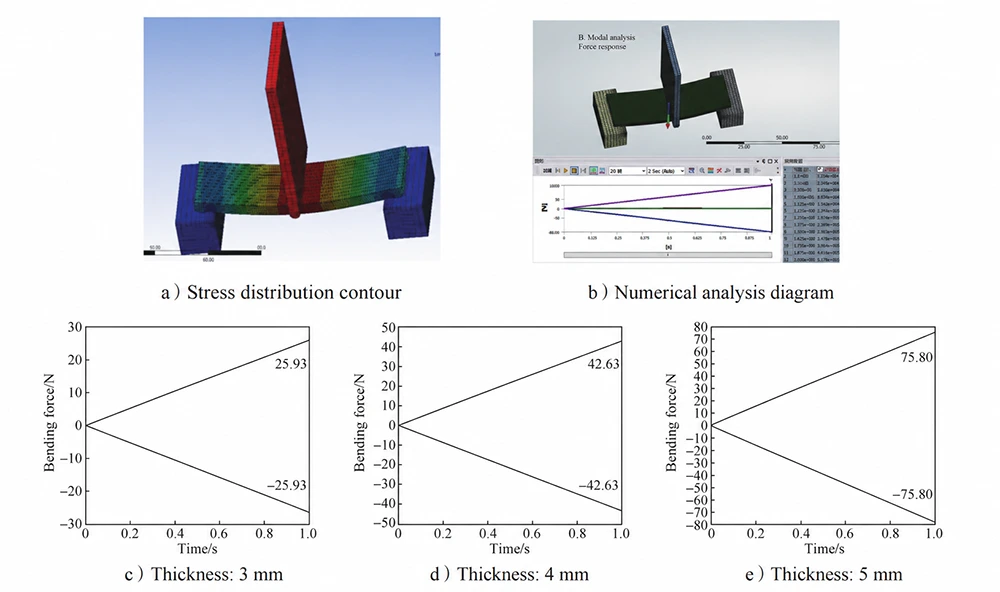
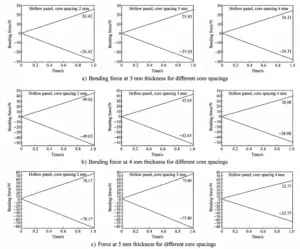
Stress and deformation were mainly concentrated in the central region of the PP corrugated sheet. Simulation results showed different bending forces across the three thicknesses.
At 3 mm thickness, the simulated bending force reached 25.93 N. The experimental value was 27.07 N, producing a 4.2% relative error.
At 4 mm thickness, simulation predicted 42.63 N against an experimental value of 43.76 N. The resulting error was 2.6%.
At 5 mm thickness, simulation predicted 75.80 N against an experimental value of 72.67 N. The corresponding error reached 4.3%.
Differences among simulated, experimental, and theoretical bending forces remained below 8%. These results support the reliability of the theoretical equations and experimental data.
They also confirm the accuracy of the finite element model.
Simulation of PP Corrugated Sheet with Different Core Layer Spacing
> Simulation Model Development
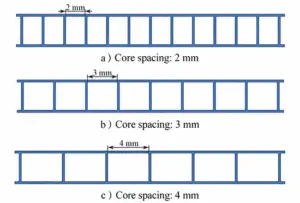
Additional structural models were developed to investigate how core layer spacing affects bending performance. The selected spacing values were 2, 3, and 4 mm.
Nine PP corrugated sheet configurations combined these spacing values with different sheet thicknesses. Their mechanical responses under bending loads were quantitatively analyzed.
| Sample | Sample Thickness (mm) | Core Layer Spacing (mm) |
|---|---|---|
| 3-2 | 3 | 2 |
| 3-3 | 3 | 3 |
| 3-4 | 3 | 4 |
| 4-2 | 4 | 2 |
| 4-3 | 4 | 3 |
| 4-4 | 4 | 4 |
| 5-2 | 5 | 2 |
| 5-3 | 5 | 3 |
| 5-4 | 5 | 4 |
Table 5. PP Corrugated Sheet Sample Parameters with Different Thicknesses and Core Layer Spacing
> Simulation and Result Analysis
The models were imported into ANSYS Workbench for finite element simulation. The analysis examined the coupled effects of thickness and core layer spacing.
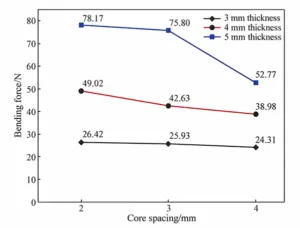
Core layer spacing showed a negative correlation with bending force. At constant thickness, bending force decreased monotonically as spacing increased.
This reduction became more pronounced as sheet thickness increased. For 3 mm sheets, increasing spacing from 2 mm to 4 mm reduced force from 26.42 N to 24.31 N.
The reduction was 8.0%. For 4 mm sheets, bending force decreased from 49.02 N to 38.98 N, representing a 20.5% reduction.
For 5 mm sheets, bending force declined from 78.17 N to 52.77 N. This represents a 32.5% reduction.
Thickness showed a positive correlation with bending force. At constant core spacing, increasing sheet thickness significantly improved bending resistance.
Smaller core spacing further strengthened this thickness effect. At 2 mm spacing, increasing thickness from 3 mm to 5 mm raised force significantly.
Bending force increased from 26.42 N to 78.17 N, representing a 196.0% increase. At 3 mm spacing, it increased from 25.93 N to 75.80 N.
This represents a 192.3% increase. At 4 mm spacing, bending force increased from 24.31 N to 52.77 N, or 117.1%.
Bernoulli-Euler beam theory explains the bending behavior of PP corrugated sheet. During bending, the upper and lower face sheets mainly withstand tensile and compressive stresses.
The core columns provide structural support. At a small sheet thickness, such as 3 mm, face sheet stiffness dominates overall behavior.
Missing core support therefore has a relatively limited effect on overall stiffness. Increasing spacing from 2 mm to 4 mm reduces bending force by only 8.0%.
At 5 mm thickness, the cantilever length of the face sheets increases. Core column support consequently becomes much more important.
Increasing core spacing reduces the number of support points. The face sheets then become more susceptible to bending deformation.
This structural change causes the bending force to decrease by 32.5%.
Conclusion
This study examined PP corrugated sheet bending performance through theoretical derivation, experimental verification, and finite element simulation. It focused on different thicknesses and core layer spacing combinations.
A corrected bending moment of inertia equation incorporating core layer spacing was derived. Compared with the traditional model, prediction accuracy improved by 8%.
The model supports preliminary bending-force predictions for sheets 3–5 mm thick with 2–4 mm core spacing. Results also reveal a clear thickness-spacing coupling relationship.
At constant core spacing, bending force increases with thickness. At constant thickness, bending force decreases as core spacing increases.
Larger sheet thickness makes the negative influence of core spacing more pronounced. Smaller core spacing strengthens the positive influence of thickness on bending resistance.
The bending modulus of PP corrugated sheet approaches saturation at a thickness of 4 mm. Further thickness increases produce substantially smaller gains in bending modulus.
Experimental and simulation results differed by less than 8%. This agreement confirms the model’s reliability for structural optimization of PP corrugated sheet packaging.
Recommended Configuration for Lightweight Packaging
For packaging loads up to 5 kg, a 3 mm thickness with 4 mm core spacing is recommended. The measured bending force reaches 24.31 N.
This configuration meets load requirements while reducing weight. It also lowers costs by 15% compared with the 3 mm thickness and 2 mm spacing configuration.
Recommended Configuration for Medium-Duty Packaging
For loads between 5 and 10 kg, a 4 mm thickness with 3 mm core spacing is recommended. Its measured bending force reaches 42.63 N.
This configuration balances bending performance and economic efficiency.
Recommended Configuration for Heavy-Duty Packaging
For loads between 10 and 15 kg, a 5 mm thickness with 2 mm core spacing is recommended. Its measured bending force reaches 78.17 N.
This configuration provides the strongest bending performance and helps prevent sheet bending failure during transportation.
Future research should expand the parameter ranges and further verify the coupling relationship. Other factors affecting bending performance should also be investigated.
Further optimization can improve the mechanical performance of PP corrugated sheet. It can also support wider applications of this material in green packaging.