


I’ve been working with clients in the warehousing, e-commerce, and auto parts industries at the source factory for many years, and I’ve seen far too many customers who purchased large quantities of foldable corrugated plastic crates fall into common pitfalls.
Many people initially thought that foldable crates would save warehouse space and reduce costs through reuse, but once the crates arrived, problems arose constantly:
Poor-quality crates would crack and jam after being folded just a few dozen times, making them completely impossible to fold and store;
Empty crates piled up in the warehouse took up just as much space as fixed crates, wasting rent for nothing;
Many manufacturers use ordinary sheet material to make folding crates, deliberately skipping the edge-folding and reinforcement processes.
When these crates are delivered in bulk, they become largely unusable after only a short time, resulting in extremely high costs for rework and restocking.
After years in this industry, I’ve come to realize that the durability and usability of folding containers hinge not on the thickness of the panels, but on the edge-folding process and the quality of the raw materials.
The vast majority of low-cost folding containers on the market rely entirely on cutting corners in manufacturing to keep prices down;
While no issues may be apparent in the short term, they pose significant long-term risks.
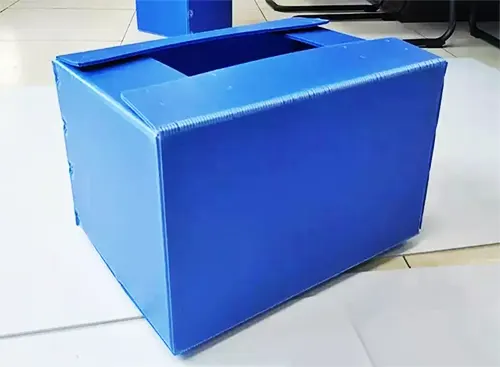
A Comparison of Three Types of Folding Crate Materials: The Price Difference Reflects a Real Disparity in Lifespan
When comparing bulk purchase prices for corrugated plastic crates, many buyers focus solely on the unit price, unaware that folding crates made from different materials vary drastically in terms of lifespan and suitability for specific applications.
Here, we’ll thoroughly explain the actual differences among the three mainstream materials on the market to help you select the right product for your needs.
New-Material, Thickened-Folded-Edge Folding Box (The Top Choice for Long-Term, High-Frequency Use)
This model is the industry standard for high-frequency industrial use. It features reinforced double-layered folded edges, and the material offers excellent overall toughness and strong resistance to bending.
Under normal operating conditions, it can be folded repeatedly over a thousand times without whitening or cracking.
Its greatest advantage is that when folded, the empty box reduces storage space by over 70%, perfectly solving the problems of warehouse stockpiling and space-consuming empty box storage.
It is suitable for long-distance logistics and reuse in small-to-medium-sized warehouses, and is currently the mainstream choice for custom corrugated folding returnable boxes.
Recycled Foldable Boxes (Suitable Only for One-Time, Short-Distance Shipments)
Made entirely from recycled materials, these boxes are extremely low-cost. However, the material is highly brittle and lacks sufficient toughness, with the folded edges being particularly fragile.
After being folded just a few dozen times, they will break and become damaged, completely losing their foldable storage functionality.
These boxes can only be used for one-time, short-distance shipments and are completely unsuitable for factory circulation.
While purchasing them in bulk may seem cost-effective, the actual cost of wear and tear is extremely high.
Standard Mixed-Material Folding Box (Suitable for Low-Frequency Temporary Use)
Manufactured using a blend of virgin material and a small amount of recycled material, this model offers a good balance of quality and value.
After repeated folding, the folds may turn white and the box may experience slight deformation.
It has an average folding lifespan and, without double-layer reinforcement, offers only average durability.
It is suitable only for low-frequency use and temporary storage of goods; it is not recommended for high-frequency use.
Biggest Procurement Mistake: Focusing Only on Box Thickness and Ignoring the Fold-Reinforcement Process
This is a pitfall that 90% of buyers fall into.
When selecting boxes, people habitually compare only the thickness of the box panels, assuming that thicker is more durable, while completely overlooking the most critical aspect: the construction at the folds.
In fact, with panels of the same thickness, the presence or absence of fold reinforcement can result in a service life that differs by several times.
In standard boxes without reinforced folds, the panels at the folding points are thin and bear concentrated stress.
After daily opening and closing, as well as stacking and compression, the folds will quickly wear down and crack.
Eventually, the box will jam and become impossible to fold, completely negating the core advantages of folding boxes—space-saving and easy storage—and rendering the entire purpose of buying them meaningless.
Hidden Tricks: Concealing Weight Limits, Leading to Cracked Boxes Under Heavy Loads
Many low-cost folding crates on the market only list external dimensions, deliberately concealing their weight limits and structural weaknesses.
These crates lack internal reinforcing ribs, resulting in poor overall structural support.
When stacked with heavy loads such as hardware or auto parts, they are prone to deformation and sidewall cracking; in severe cases, the cargo may even collapse and fall out.
In contrast, legitimate and compliant folding corrugated plastic crates feature built-in, integrally molded reinforcing ribs, ensuring a sturdy structure.
Manufacturers clearly specify the recommended weight capacity range, and these crates will not deform even when stacked under heavy loads, making them suitable for industrial heavy-duty logistics applications.
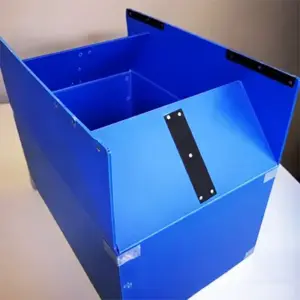
4 Practical Methods for Identifying High-Quality Foldable Hollow Board Boxes on the Spot
Without specialized equipment, anyone can perform simple on-site tests to avoid 99% of substandard boxes—making these methods extremely practical.
Repeated Folding Test
Manually fold the box back and forth about 50 times.
High-quality, reinforced boxes will show no whitening or cracks along the folded edges and will open and close smoothly; substandard boxes will immediately show whitening, warping, or even fine cracks.
Inspect the Flange Structure
High-quality boxes feature double-layered, reinforced flanges with smooth, rounded edges and no thin spots or notches;
Low-quality boxes have thin flanges with sharp corners that are highly prone to breaking under stress.
Full-Load Weight and Stacking Test
Fill the box with suitable cargo, stack multiple layers, and leave them for half an hour.
High-quality boxes remain flat without deformation, and the side walls do not bulge; low-quality boxes will show noticeable dents and deformation.
Examine the Color of the Raw Material
Boxes made from virgin material have a translucent, uniform color without impurities;
Boxes made from recycled or mixed materials have a dull, grayish color with specks and a rough texture.
Honest Insights from the Factory: We Recommend the Right Products for Your Needs, Not Just High-Priced Ones
Having been in this industry for so long, I’ve always believed that selecting the right product for your needs is more important than whether it’s cheap or expensive.
For example, when Wenzhou Naideli processes customer orders, we always start by clarifying the customer’s warehouse space, the weight per box, and the turnover frequency.
We then make targeted recommendations for standard or reinforced folding crates, while honestly disclosing each model’s folded lifespan, weight capacity, and suitable applications.
We never exaggerate product performance just to secure an order, nor do we pass off substandard crates to customers.
Many novice buyers ask about the minimum order quantity for custom corrugated plastic folding containers.
There is no rigid, industry-wide standard. For standard-sized, in-stock items, the minimum order quantity is low, and we support small-batch trial orders.
For models involving size modifications, logo printing, or structural customization, the minimum order quantity is slightly higher, fully accommodating the procurement needs of large, medium, and small factories.
We currently offer a comprehensive range of customizable products, including standard folding honeycomb boards, flip-top storage bins, and small folding storage boxes.
All support logo printing and size customization to meet the warehousing and logistics needs of various industries.
Finally, it’s worth noting that while many factories may appear to save a little on procurement costs by purchasing low-quality, low-priced folding boxes in bulk, the frequent replacement of boxes, warehouse rent tied up by empty boxes, and damage to goods actually result in significantly higher costs over the long term.
If you’re unsure which specifications are best suited for your specific operating conditions, simply provide details such as warehouse size, weight per box, and turnover frequency, and we’ll match you with the most suitable folding box size and style to reduce procurement losses at the source.
Conclusion
Choosing the right foldable corrugated plastic crate is not simply a matter of comparing unit prices or panel thickness. Material quality, fold-reinforced edges, structural strength, load capacity, and folding durability all directly affect the crate’s actual service life and total cost of ownership.
For warehouses, e-commerce operations, and auto parts logistics, a high-quality folding crate can significantly reduce empty-storage space, withstand repeated handling and folding, and remain reliable throughout long-term circulation.
By contrast, low-cost crates with poor materials or inadequate reinforcement may quickly crack, deform, or lose their folding function, turning a seemingly low-cost purchase into a costly replacement and operational burden.
Before placing a bulk order, buyers should therefore evaluate the material, folding structure, reinforcement design, load capacity, and expected turnover frequency—not just the quoted price.
A short folding test, flange inspection, load test, and raw-material check can also help identify many quality problems before they reach the warehouse.
Ultimately, the best folding crate is not necessarily the cheapest or the thickest one. It is the one whose material, structure, durability, and specifications match your actual operating conditions.
Choosing the right product from the beginning can reduce replacement costs, save valuable warehouse space, protect your goods, and deliver much better long-term value.