


PP corrugated plastic sheets are widely seen in electronics factories, packaging workshops, as well as warehousing and logistics facilities.
These boards have multiple superior properties. They are lightweight, moisture-resistant, recyclable, and anti-static.
For these reasons, they have become the standard packaging option for precision electronics, PCBs and various components.
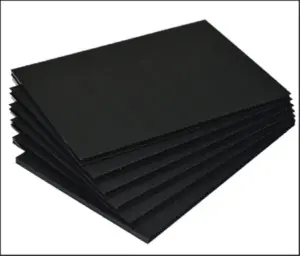
But I don’t know if you’ve noticed something: almost all the anti-static corrugated plastic sheets on the market are black.
The occasional blue, white, or gray ones you see are mostly standard corrugated plastic sheet, not true anti-static models.
Many people ask: Can’t they be made in lighter colors? Black isn’t attractive, and it’s hard to see the materials inside—so why does it have to be black?
Today, I’ll use this article to explain this “unwritten rule” of the industry.
Key Reason: Anti-Static Protection Relies on “Black Carbon Black”
Manufacturers do not produce truly permanent anti‑static corrugated plastic sheet by spraying anti‑static liquid or applying a film; instead, they directly add conductive carbon black to PP plastic raw materials.
Carbon black is an ultrafine black powder that forms a conductive network within the sheet.
Static electricity may build up. The carbon black channels can rapidly conduct it away and deliver this fast static‑dissipation effect.
Its surface resistance stays stable within the range of 10⁶–10⁹ Ω. This performance satisfies ESD anti‑static standards.
With carbon black added, the sheet naturally turns black.
If you want to produce light-colored or white sheets that also provide permanent anti-static protection, it is either impossible or would double the cost.
Light-Colored Boards Are “Not Durable and Do Not Last Long”
You can occasionally spot blue and white anti‑static boards on the market. Most of these products belong to the surface‑coated anti‑static board type.
Their characteristics are clear:
Manufacturers coat their surface with only a single layer of antistatic agent.
After friction, wiping, or washing, the antistatic effect rapidly diminishes.
After a period of use, they become ordinary plastic sheets and no longer provide antistatic protection.
For electrostatic-sensitive products such as chips, precision electronics, and PCBs, this type of “short-term antistatic protection” is simply too risky to use.
Black = More Durable, More Resistant to Aging, and More Cost-Effective
In addition to meeting essential performance requirements, black corrugated plastic sheet offer significant advantages in practical use:
① Resistant to dirt and oil stains, keeping the workshop looking tidier
Solder dross, dust, and oil stains often accumulate inside electronics factories.
Black corrugated plastic sheet hide marks well. Therefore, users do not need frequent cleaning. They maintain a presentable appearance even with long‑term use.
② Carbon black naturally provides UV resistance and resistance to aging
Black absorbs UV rays, so even when used outdoors, in open areas, or in long-term circulation, the panels are less prone to becoming brittle, cracking, or aging, resulting in a longer lifespan than lighter-colored panels.
③ Lower cost and better value for bulk purchases
Conductive carbon black is a mature, inexpensive, and easily sourced raw material.
Manufacturers can mass‑produce black anti‑static corrugated plastic sheet at a stable price, making them the best value‑for‑money option for electronic packaging, storage bins, blade holders, and dividers.
Industry Consensus: Black = Anti-Static, Instantly Recognizable
In the electronics manufacturing and packaging industries, a common understanding has taken hold:
Black hollow-core panels = permanent anti-static.
Other colors = standard panels / short-term anti-static panels.
Factory floor workers, logistics staff, and warehouse managers can distinguish them at a glance.
This stops personnel from mixing standard panels into anti‑static areas and damaging or breaking down components.
Summary
It’s not that we don’t want to make colored versions; it’s just that there’s no need, and it’s not cost-effective.
In a nutshell:
The reason anti-static corrugated plastic sheet are black is that their anti-static properties come from the black conductive carbon black itself.
Black = Permanent anti-static protection.
Black = Stable and reliable performance.
Black = Durable, rugged, and low-cost.
Light-colored anti-static panels are either short-lived or exorbitantly priced; for the vast majority of companies, black is the most practical and safest choice.