


Packaging is no longer a standalone product in the supply chain, but rather a vital link that runs throughout the entire supply chain.
It is precisely because of this shift in role that reducing the total cost of packaging in the supply chain through circular packaging solutions has become a key strategy.
Introduction to Reusable Packaging Products
This section provides a detailed introduction to reusable packaging products, presented in a non-sequential order.
We introduce the first reusable packaging product here: reusable packaging containers made of Corrugated Plastic Sheets.
Organizations have issued a group standard for corrugated plastic sheet recycling packaging containers:
T/SHBX 003-2022 “ corrugated plastic sheet Recycling Packaging Containers.” This standard defines them as follows.
We refer to packaging containers (boxes) made from Corrugated Plastic Sheets that are suitable for repeated use as corrugated plastic sheet recycling packaging containers.
corrugated plastic sheet material is a type of plastic sheet formed through molding processes such as extrusion, using resins like polyethylene or polypropylene as the primary raw material.
It consists of one or more layers with a hollow structure between them.
The term “hollow structure” refers to the presence of a certain amount of space within the structural section between the surface layer and the base layer of the sheet.
The shape of this structure and its height directly affect the thickness of the sheet.
If we classify calcium-plastic boxes, PP hollow board boxes, and PP honeycomb board boxes as a series of iterative products, I define the “calcium-plastic box” as version 1.0 of the corrugated plastic sheet reusable packaging container.
I define the “PP hollow board box” as version 2.0. I define the “PP honeycomb board box” as version 3.0.
Below, I will introduce these three types of container products individually.
Calcium-Plastic Boxes—Version 1.0 of Recyclable Packaging Containers Made from Corrugated Plastic Sheets
Engineers use ‘calcium-plastic boxes’ as a shortened term for corrugated boxes made from calcium-plastic material.
They can consider them China’s first generation of industrialized corrugated plastic returnable containers, which manufacturers invented in the 1970s and 1980s.
At that time, corrugated cardboard boxes had poor moisture resistance and high single-use wastage, while wooden boxes were costly.
Consequently, the industry developed calcium-plastic material.
This is a new material created by modifying thermoplastic resins such as polyethylene and polypropylene with inorganic salts like calcium carbonate and calcium sulfate.
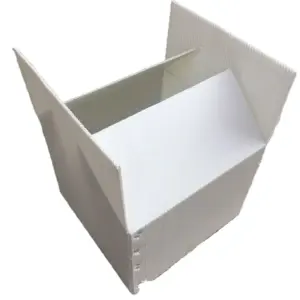
Its structural form and applications are essentially the same as those of corrugated cardboard boxes.
The achievement of large-scale mass production of plastic packaging gave rise to the category of calcium-plastic board boxes, which served as the pioneering product for corrugated plastic packaging boxes.
1. Background and Development
For this reason, they are grouped together and referred to as Version 1.0 of corrugated plastic sheet recycling containers.
In the early days, these products rapidly captured the agricultural by-products, daily chemicals, and low-end hardware packaging markets due to the easy availability of raw materials and low production costs.
At that time, there was also a type of filled and modified hollow sheet material.
It was produced by compounding with foaming agents and stabilizers, then cut, nailed, and folded into storage and transport containers, and classified under the category of filled and modified hollow sheet containers.
2. Application Scenarios and Key Markets
Manufacturers leverage their low-cost advantage to target calcium-plastic boxes primarily at the mid-to-low-end consumer and traditional light industrial markets.
These include the wholesale and transshipment of fruits, vegetables, and agricultural byproducts.
They also include the warehousing of daily chemical products and small commodities.
Short-distance transport of general hardware items; and simple packaging for small postal parcels.
Due to performance limitations, we cannot use them for cold storage, heavy-duty stacking, or protecting precision products.
With the subsequent emergence of PP hollow-core plastic crates, we gradually phased them out.
Authorities also repealed the original Chinese national standard GB/T 6980-1995 ‘Calcium-Plastic Corrugated Boxes.
However, calcium-plastic crates are still in use in some wholesale and transshipment markets for fruits, vegetables, and agricultural byproducts.
PP Hollow Board Boxes—Version 2.0 of Recyclable Plastic Sheet Packaging Containers
With the industrial-scale mass production of polypropylene and upgrades to plastic extrusion equipment, the early 1990s saw the gradual development of PP-based materials.
These materials replaced modified PE calcium-plastic sheets.
Calcium-plastic sheets, which contained large amounts of calcium powder, suffered from insufficient toughness and a tendency to become brittle and crack at low temperatures.
1. Transition to PP Hollow Sheet Technology
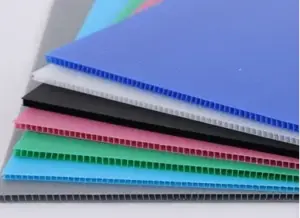
To address these shortcomings, we developed a new type of sheet using pure modified PP material with a monolithic extruded honeycomb structure.
By eliminating excessive calcium carbonate fillers, these sheets achieve a balance between lightweight design and impact resistance through their hollow rib structure.
The production process has evolved from hot pressing to continuous extrusion, resulting in significantly higher mass production efficiency and superior weather resistance compared to calcium-plastic boxes.
This has established them as the primary product for industrial reusable packaging and the most widely used hollow box product on the market today.
2. Structural Design and Mechanical Performance
The panels consist of two flat outer layers connected by “ribs” (vertical ribs or struts) in the middle, forming a series of closed or semi-closed hollow chambers.
This structure leverages principles of physics and mechanics, with the central ribs providing robust support.
When external pressure (such as stacking loads) or impact forces act on the panel, the hollow structure rapidly disperses the force across the entire panel surface.
This design achieves maximum structural strength and compressive resistance with minimal plastic material.
For the same weight, hollow panels are significantly stronger than solid panels; for the same strength, they weigh only 30%–50% of solid panels.
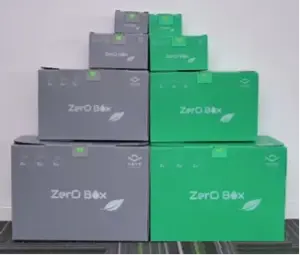
Manufacturers produce these reusable containers from pure polypropylene (PP) pellets through single-screw, one-step extrusion.
They consist of single-layer, monolithic lattice hollow panels with vertical rectangular ribs in the center.
Manufacturers assemble them through heat bending, nailing, and plastic edge sealing, and they classify them as one-piece extruded hollow panel containers.
PP Honeycomb Panel Boxes—Version 3.0 of Recyclable Plastic Hollow Panel Packaging Containers
With the surge in demand for lightweight logistics solutions in the automotive, precision electronics, and high-end equipment industries, standard grid-pattern hollow panels have proven insufficient.
They fall short in terms of bending strength and load-bearing capacity.
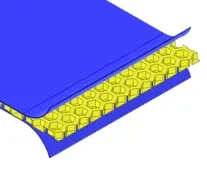
Drawing inspiration from honeycomb mechanical structures, the industry has developed PP honeycomb panels.
These panels feature a sandwich structure composed of upper and lower PP facings bonded to a central honeycomb core.
“Manufacturers use eco-friendly adhesives to thermally press these layers into a single sheet.
They then process the sheet into panel boxes or one-piece returnable containers, resulting in a composite sandwich-type hollow panel container.
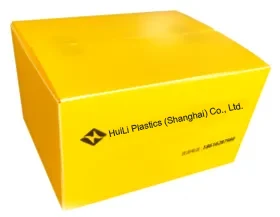
This represents the premium form of hollow-structure packaging.
Targeting mid-to-high-end precision logistics applications, this product marks an evolution in hollow panel packaging toward higher strength, lighter weight, and extended cycle life.
It fills the gap in high-end returnable solutions for heavy-load, cleanroom, and anti-static environments.
Conclusion
The evolution of corrugated plastic sheet reusable packaging clearly reflects a broader transformation in modern logistics—from single-use, cost-driven packaging toward durable, system-oriented, and circular packaging solutions.
Across the three generations of products—calcium-plastic boxes (Version 1.0), PP hollow board boxes (Version 2.0), and PP honeycomb board boxes (Version 3.0)—we can observe a consistent trajectory of material optimization and structural engineering advancement.
Each iteration addresses the limitations of its predecessor, offering improved toughness, enhanced load-bearing performance, increased weather resistance, and progressively higher lifecycle efficiency.
Calcium-plastic boxes represent the initial industrial attempt to replace traditional wood and cardboard packaging with low-cost plastic alternatives, but their performance constraints limited their long-term applicability.
PP hollow board boxes introduced a major leap in structural design through extrusion-based hollow rib architecture, achieving a practical balance between strength, weight, and manufacturability, which enabled large-scale adoption in industrial logistics.
PP honeycomb board boxes further elevate the concept by adopting sandwich composite structures inspired by natural mechanics, enabling superior rigidity, reduced weight, and suitability for high-end, precision, and cleanroom environments.
Taken together, these developments demonstrate that reusable corrugated plastic packaging is no longer merely a material substitution issue, but a structural systems engineering problem integrating materials science, mechanical design, and supply chain efficiency.
As circular economy principles continue to reshape industrial logistics, the future of reusable packaging will likely move toward even more advanced composites, standardized modular systems, and highly specialized designs tailored to specific industry requirements.
The ultimate direction is clear: packaging is evolving from a consumable cost item into a durable, reusable asset within the supply chain ecosystem.