


As supply chains continue to undergo upgrades, transformations, and optimizations, the standardization, reduction, and greening of logistics packaging have become a consensus within the industry.
Amid the ongoing integration of the logistics packaging industry chain, a new type of hollow plastic panel—plastic corrugated panels—is gradually gaining market favor due to its lightweight, high-strength, eco-friendly, and low-cost advantages, and is gradually replacing existing hollow plastic panels in certain sectors.
Introduction and Evolution of Hollow Plastic Sheets
Hollow plastic sheets are a relatively common type of plastic product. Due to the inherent properties of plastic—such as water resistance, moisture resistance, and durability—combined with the sheets’ ease of processing and foldability, they are frequently used to manufacture packaging containers.
They offer distinct advantages in the transportation and transshipment of fresh fruits and vegetables, as well as in the field of reusable packaging, and have gradually developed their own industrial chain.
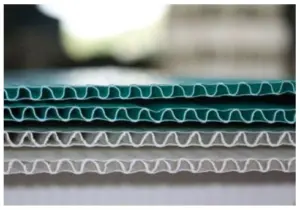
Early hollow plastic sheets were calcium-plastic boards. Their hollow core structure, as shown in Figure 1, is similar to the corrugated wave structure of corrugated cardboard, which is why they are often referred to as plastic corrugated boards.
Subsequently, with technological advancements in hollow plastic sheet production and the reduction of excessive calcium carbonate in raw materials, polypropylene (PP) became the primary raw material for extrusion processing, leading to the emergence of “second-generation” hollow plastic sheets.
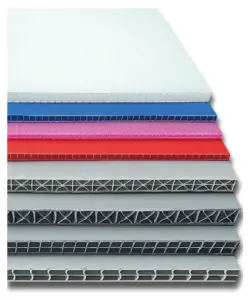
Due to their raw material composition, these are often referred to as PP hollow sheets. Their extrusion structures are diverse; Figure 2 illustrates a structural diagram showing various hollow core layer configurations.
Introduction to Plastic Corrugated Panels
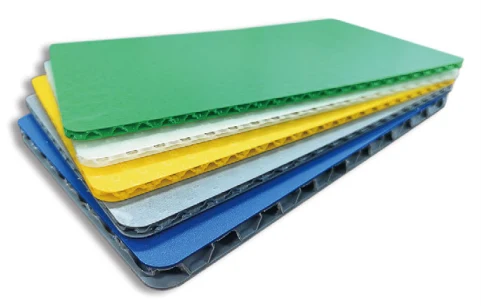
Plastic corrugated panels are a new type of hollow plastic panel made from polypropylene, featuring a corrugated-shaped core layer in the central hollow space, which is bonded to the outer layers using multi-layer co-extrusion technology.
Figure 3 shows an example of a plastic corrugated panel.
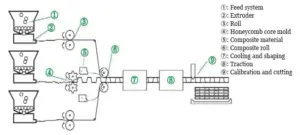
The manufacturing process is shown in Figure 4.
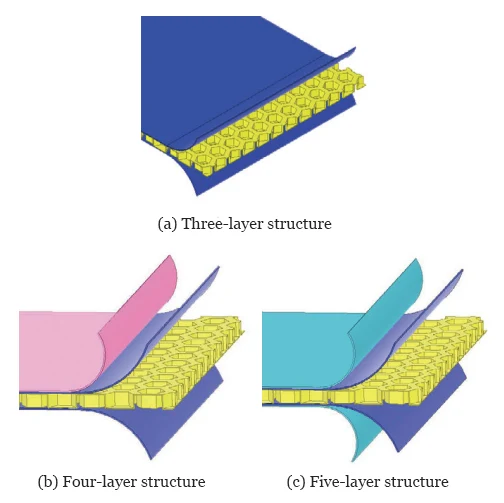
Conventional plastic corrugated panels have a three-layer structure, as shown in Figure 5(a).
Due to the characteristics of their manufacturing process, the surface layers of plastic corrugated panels can be modified.
If certain products have specific functional requirements for packaging containers, surface modification during the manufacturing process can be used to produce panels with special properties such as fire resistance, slip resistance, UV resistance, and antistatic properties.
The structures of corrugated panels after surface modification are shown in Figures 5(b) and (c).
Specifications and Thickness Classification
Typically, the specifications of plastic corrugated panels are defined based on the panel thickness and the panel’s square meter weight, as shown in Table 1.
| Plastic corrugated Panel Thickness (mm) | 3 | 4 | 5 | 8 | 10 | 12 |
|---|---|---|---|---|---|---|
| Minimum Areal Density (g/m²) | 700 | 800 | 1000 | 2000 | 2500 | 3000 |
| Maximum Areal Density (g/m²) | 1000 | 1500 | 2000 | 3000 | 4000 | 5000 |
Table 1. Specifications for Plastic corrugated Panels
The parameters defined by these specifications also determine which plastic corrugated panel thicknesses are suitable for different logistics scenarios. Generally, plastic corrugated panels range in thickness from 3 to 12 mm.
Based on panel thickness, plastic corrugated panels between 3 and 5 mm are classified as thin panels and are suitable for manufacturing standard shipping containers designed to hold small-volume contents weighing up to 100 kg;
Applications and Industry Position
Plastic corrugated panels with a thickness of 8–12 mm are classified as thick panels and are suitable for manufacturing large reusable pallet boxes designed to carry contents weighing between 100 and 500 kg.
Plastic corrugated panels also fall under the category of hollow plastic sheets.
From the perspective of usage and applications, they can replace traditional PP hollow sheets, but they offer a broader range of applications compared to PP hollow sheets.
Because their surface layers can undergo special treatments, and their greater thickness and higher density specifications allow them to support heavier products, their applications are more extensive.
They can be regarded as the “third generation” of plastic hollow sheets.
Manufacturing and Applications of Plastic Corrugated Panel Boxes
Plastic corrugated panels share the same processing characteristics as PP hollow panels and can also be transformed into packaging boxes or various packaging components through secondary processing.
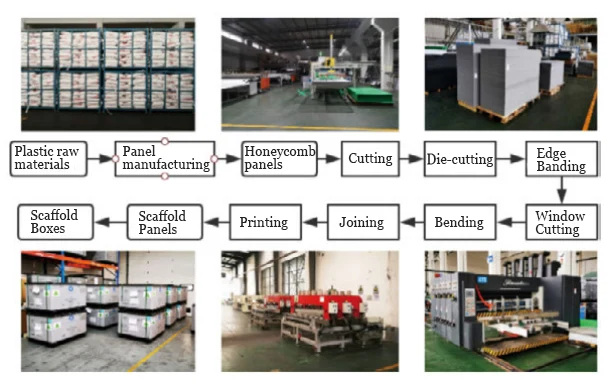
The production process for plastic corrugated panel boxes, from raw materials to finished products, is shown in Figure 6.
If the material is to be used for packaging components, only some of these processes may be required.

Structural Differences and Performance Requirements
The finished plastic corrugated panel packaging box is shown in Figure 7. Since its manufacturing process differs somewhat from that of traditional corrugated cardboard boxes, there are also slight differences in their intended uses;
However, certain requirements must still be met during the manufacturing process. For example, there are specific requirements for the edge sealing of plastic corrugated panel packaging boxes.
Unlike corrugated cardboard boxes, where the corrugations can be left exposed, these boxes are designed for repeated use and must meet waterproof and dustproof standards; therefore, edge sealing is essential.
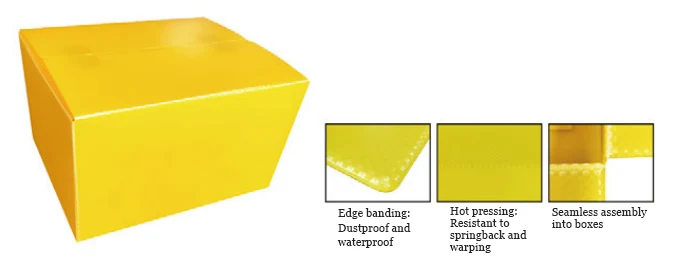
At the same time, unlike corrugated cardboard boxes, which require tongue-and-groove joints to form the box, plastic corrugated panels can be assembled into boxes through seamless joining—a process made possible by the unique properties of the material.
Reusability and Mechanical Advantages
If a box is reused ten or more times, the per-use cost of a plastic corrugated panel box becomes lower than that of a corrugated cardboard box, while the box’s puncture resistance and compressive strength are increased severalfold.
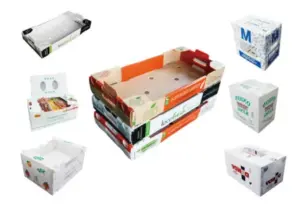
Plastic corrugated panels can also be die-cut and folded just like corrugated cardboard.
Figure 8 shows a transport and display box for fresh produce made using these die-cutting and folding capabilities;
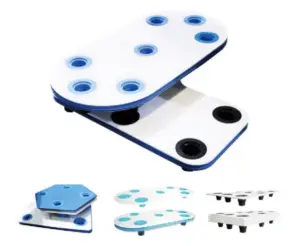
They can also be combined with other plastic components to create lightweight plastic pallets, as shown in Figure 9.
Due to their varying thicknesses and specifications, plastic corrugated panels are more suitable than PP hollow panels for manufacturing corrugated panel crates.
These crates are particularly well-suited for use in the logistics and transportation industry as reusable packaging, offering distinct advantages and applicability, especially for large packaging containers.
The following section provides a detailed overview of the production and manufacturing of plastic corrugated panel crates.
Assembly Structure of Reusable Containers
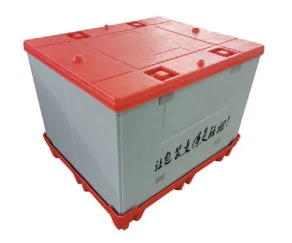
A complete plastic corrugated panel container is formed by folding and assembling plastic top and bottom lids with plastic corrugated panel sides, as shown in Figure 10.
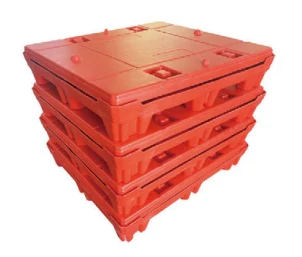
Typically, plastic corrugated panel containers designed for reusable circulation should be configured as shown in Figure 11, which helps save space during recycling and reduces recycling costs.
Therefore, the panels in plastic corrugated panel pallet boxes are primarily made of plastic corrugated panels, and the manufacturing process is shown in Figure 12.
Conclusion
Plastic hollow board packaging materials have long been a staple in the logistics packaging industry.
As they have continuously adapted to the demands of economic and social development, they have evolved into a three-tiered series of derivative and upgraded products: “calcium-plastic boards—PP hollow boards—plastic corrugated panels.”
With the further refinement and widespread adoption of plastic corrugated panel manufacturing processes, and in line with the requirements of a circular economy, plastic corrugated panels and related products are poised for even greater growth.